.png)
Few home improvement projects create as much confusion as party wall matters. A homeowner decides to build a rear extension, convert a loft, or excavate a basement. The drawings are approved, builders are lined up, and work is ready to start. Then somebody asks a simple question:
"Have you got a party wall agreement?" For many people, that's the first time they've heard the term.
Some assume it's just a form that neighbours sign. Others believe it gives them permission to build. Neither is quite right.
The reality is that a party wall agreement forms part of a legal process designed to protect both property owners when certain construction works affect shared walls, boundaries, or neighbouring structures. It sits alongside planning permission and Building Regulations but serves a completely different purpose. Understanding what is a party wall agreement, when it's required, and how the process works can save significant time, money, and neighbour disputes later on.
This guide will help you understand the party wall agreement process, costs, legal obligations, and what happens if a neighbour objects to your proposed works.
.webp)
One of the biggest misconceptions is that a party wall agreement is simply a document signed by neighbours.
In practice, the term is often used to describe the formal arrangements made under the Party Wall etc. Act 1996 when construction works affect a party wall, boundary structure, or nearby foundations. So this brings us to the question: what is a party wall agreement exactly? It's the legal framework that allows certain building works to proceed while protecting the rights of neighbouring owners.
The agreement may arise in one of two ways:
The purpose is not to stop development. Instead, it seeks to balance the rights of both parties. The building owner can carry out lawful construction works.
The adjoining owner receives protection against unnecessary risk or damage. Without a properly managed party wall agreement, even relatively straightforward projects can become complicated.
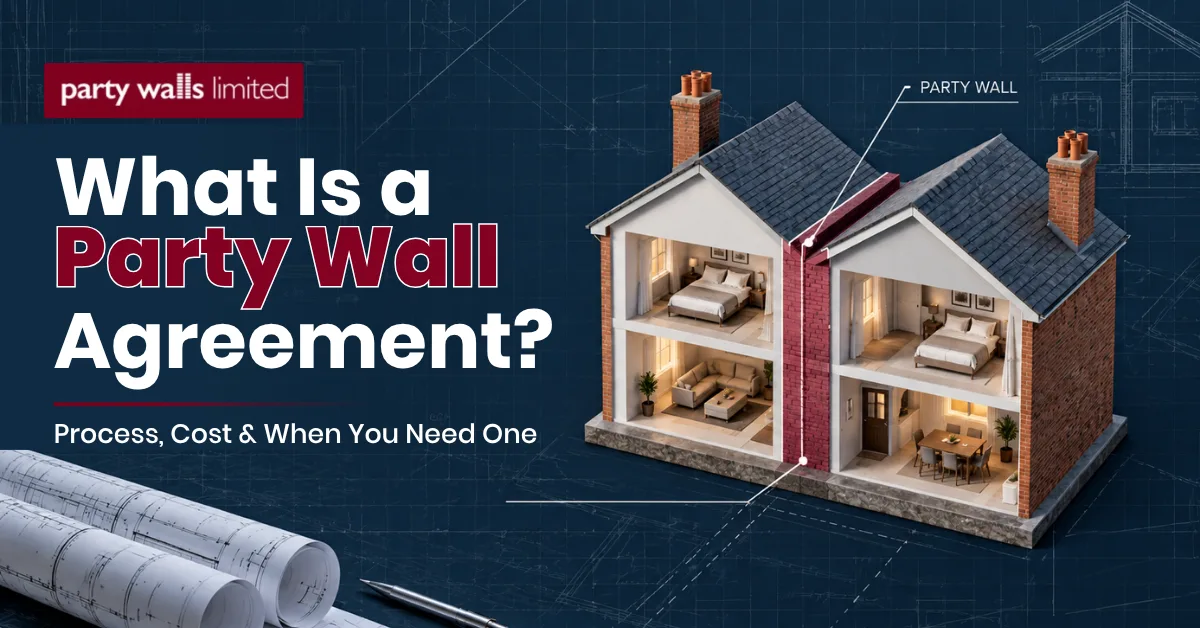
Before discussing the party wall agreement process, it's worth understanding what the law considers a party wall and structure.
A party wall generally refers to a wall shared by two properties.
Common examples include:
In older London terraces, for example, the wall running between neighbouring properties is usually a party wall. The Act can also apply to excavations close to neighbouring buildings, even where no shared wall exists.
This is why homeowners are often surprised to discover that foundations and basement works can trigger Party Wall requirements.
.webp)
One of the most common questions homeowners ask is:
The answer depends on the nature of the proposed works.
Typical projects requiring Party Wall procedures include:
Many loft conversions involve inserting steel beams into a shared wall.
Because the wall is being altered structurally, Party Wall procedures are often required.
Excavating foundations close to neighbouring buildings comes within the Section 6 of the Act.
Basement projects are among the most common triggers for Party Wall disputes due to concerns about structural movement and neighbouring foundations.
Notice is required under the Act for removing chimney breasts, cutting into shared walls, or inserting structural supports.
Building directly on or at the boundary line can trigger additional obligations.
A good rule of thumb is this: If your works affect a shared structure or involve excavation near a neighbouring property, professional advice should be sought before construction begins.
The party wall agreement process follows a clear legal framework.
Many disputes occur because homeowners skip steps or misunderstand the sequence.
Before serving any notice it is important to establish whether the proposed works fall under the Party Wall etc. Act 1996.
Not every extension or renovation requires Party Wall procedures.
If the Act applies then the building owner must serve a Party Wall Notice to the affected neighbours.
The notice should describe:
The adjoining owner can do the following:
If they consent then the process may remain relatively straightforward.
But if they dissent then surveyors must be appointed.
Appointment of surveyors depends up on the circumstances:
A detailed record of the neighbouring property's condition is usually prepared before works begin, and is referred to as a Schedule of Condition.
This helps in the protection of both parties if damage claims arise later.
Surveyor(s) prepare a legally binding Party Wall Award outlining the following:
This concludes the formal party wall agreement process.
.webp)
Another question surveyors hear regularly is:
The answer depends on the neighbour's response. If the neighbour consents to the notice in writing, the agreement can often be achieved without appointing surveyors. However, many homeowners still choose to prepare a Schedule of Condition for added protection.
Where the neighbour dissents or fails to respond, surveyors must be appointed and a Party Wall Award is prepared. The safest approach is usually to seek professional advice before serving notices.
Poorly drafted notices are one of the most common causes of delays.
Homeowners occasionally search for a third party wall agreement, often after hearing the term "third surveyor."
The two concepts are slightly different. Under the Act, if two appointed surveyors cannot agree on a particular issue, a Third Surveyor may be called upon to make a decision. The Third Surveyor is elected by the two primary surveyors at the very beginning of the party wall process. This does not create a separate third party wall agreement. Instead, it forms part of the dispute resolution mechanism built into the legislation.
The Third Surveyor acts independently and helps resolve disagreements between the appointed surveyors.
Costs vary significantly depending on the project.
Anyone searching online for a fixed figure is likely to be disappointed.
The overall cost depends on factors such as:
A straightforward loft conversion with neighbour consent may involve relatively modest costs. A basement excavation affecting multiple neighbouring properties will usually involve considerably higher professional fees.
In most situations, the building owner pays reasonable surveyor costs associated with the process. Attempting to save money by ignoring Party Wall requirements often proves more expensive later.
A neighbour cannot simply stop lawful works from proceeding because they dislike the project.
However, they are entitled to protections under the Act.
If a neighbour refuses consent:
This is a normal part of the process.
Many homeowners hear the word "dispute" and assume legal conflict is inevitable. In reality, most Party Wall disputes are administrative rather than hostile.
The surveyors' role is to ensure both parties are treated fairly.
Having dealt with countless Party Wall matters, several recurring issues appear again and again.
Builders arrive before notices are served.
This can create immediate legal complications.
Planning approval and Party Wall obligations are completely separate.
One does not replace the other.
Most disputes become worse when communication breaks down.
A conversation early in the process often prevents problems later.
Notices that contain errors can delay projects and create uncertainty.
Party Wall procedures take time.
Leaving everything until the last minute creates unnecessary pressure.
The Party Wall etc. Act 1996 was designed to balance competing interests. Property owners should be able to improve their homes.
Neighbours should be protected from unnecessary risk. On paper, the legislation appears straightforward. But in practice, every project presents slightly different circumstances.
Professional guidance will help you ensure:
Most importantly, it helps homeowners avoid mistakes that can delay construction or damage neighbour relationships.
You should understand the party wall agreement process before starting construction works that might affect the neighbouring properties.
If you're planning a loft conversion, rear extension, basement excavation, or structural alteration then knowing when a party wall agreement is required can help prevent delays and disputes later. For homeowners who are asking about what is a party wall agreement then the simplest answer is that it's a legal mechanism designed to protect both the parties while allowing necessary construction work to proceed.
The process is rarely as complicated as people fear, provided it is handled correctly from the outset. If you’ve been asking yourself: “how do I get a party wall agreement”, or whether your project falls under the Act then obtaining professional advice before work begins can save significant time, cost, and stress.
A properly managed Party Wall process helps projects move forward smoothly while preserving good neighbour relationships and ensuring compliance with the law.

Yes. If a Party Wall Award has been issued then it becomes legally binding unless it is successfully challenged through the appropriate legal process.
The agreement remains relevant for the duration of the works covered by it and any obligations arising from those works, unless stated otherwise in an Award (stating something similar to "The rights conferred by this Award shall cease if the Building Owner's works have not commenced within twelve months from the date of service of this Award...").
However, the notice itself has a statutory time limit. If the notified work has not begun within 12 months from the date of service of the notice, the notice ceases to have effect.
Many loft conversions consist of structural works to shared walls, particularly when steel beams are installed.
In most circumstances, the building owner undertaking the works pays the reasonable costs associated with the Party Wall process.
Sometimes. If neighbours provide written consent, surveyors may not be required. However, professional advice is often beneficial, and surveyors will be required if a dispute arises.
The process does not just simply end. Surveyor(s) must be appointed and a Party Wall Award prepared under the Act.
No. Planning permission and Party Wall procedures are entirely separate legal requirements.
Yes. However, unresolved Party Wall issues or undocumented works may raise questions during the conveyancing process.