.png)

You’ve planned a home extension, loft conversion or basement project in London, but before your builders arrive, there's one important legal requirement that many homeowners overlook and that is the Party Wall Process.
In a city where Victorian terraces, semi-detached homes and closely built properties dominate entire neighbourhoods, construction work often affects neighbouring buildings. Failing to follow the correct legal process can lead to costly delays, damaged relationships with neighbours, and even court injunctions that bring your project to a halt.
A qualified party wall specialist helps you comply with the Party Wall etc. Act 1996 by managing notices, resolving disputes and protecting both property owners throughout the construction process.
This guide explains exactly when you need a party wall agreement, what a specialist actually does, how the process works, what costs you should expect in London, and why professional guidance can save you significant time, money and stress.
The Party Wall etc. Act 1996 is designed to protect both building owners and adjoining owners whenever construction work affects shared walls, boundaries or nearby structures.
A party wall agreement (more accurately known as a Party Wall Award when surveyors become involved) establishes the legal rights and responsibilities of both parties before work begins.
You will usually need a party wall agreement if your project involves:
Ignoring these requirements is a significant risk.
If work starts without following the Act, your neighbour may apply to the court for an injunction that stops construction immediately. Legal fees, contractor delays and redesign costs can quickly run into thousands of pounds, making early professional advice a worthwhile investment.
.webp)
London presents unique challenges for residential construction.
Many homes share walls, foundations or structural elements, while basement developments have become increasingly common in high-value boroughs. These characteristics make specialist knowledge essential.
A party wall expert understands the legal framework as well as the practical issues associated with London's diverse housing stock.
Unlike a general building surveyor, a specialist focuses exclusively on matters governed by the Party Wall etc. Act 1996.
Their responsibilities typically include:
Preparing legally compliant notices with the correct information and ensuring they are served within the required timescales.
Before work begins, the surveyor records the condition of neighbouring properties through a detailed photographic inspection. This protects both parties if concerns about damage arise later.
Where neighbours dissent or fail to respond, surveyors prepare legally binding party wall awards that set out how the works will proceed while protecting adjoining properties.
An experienced party wall surveyor acts impartially, helping neighbours reach practical solutions without unnecessary conflict or delays.
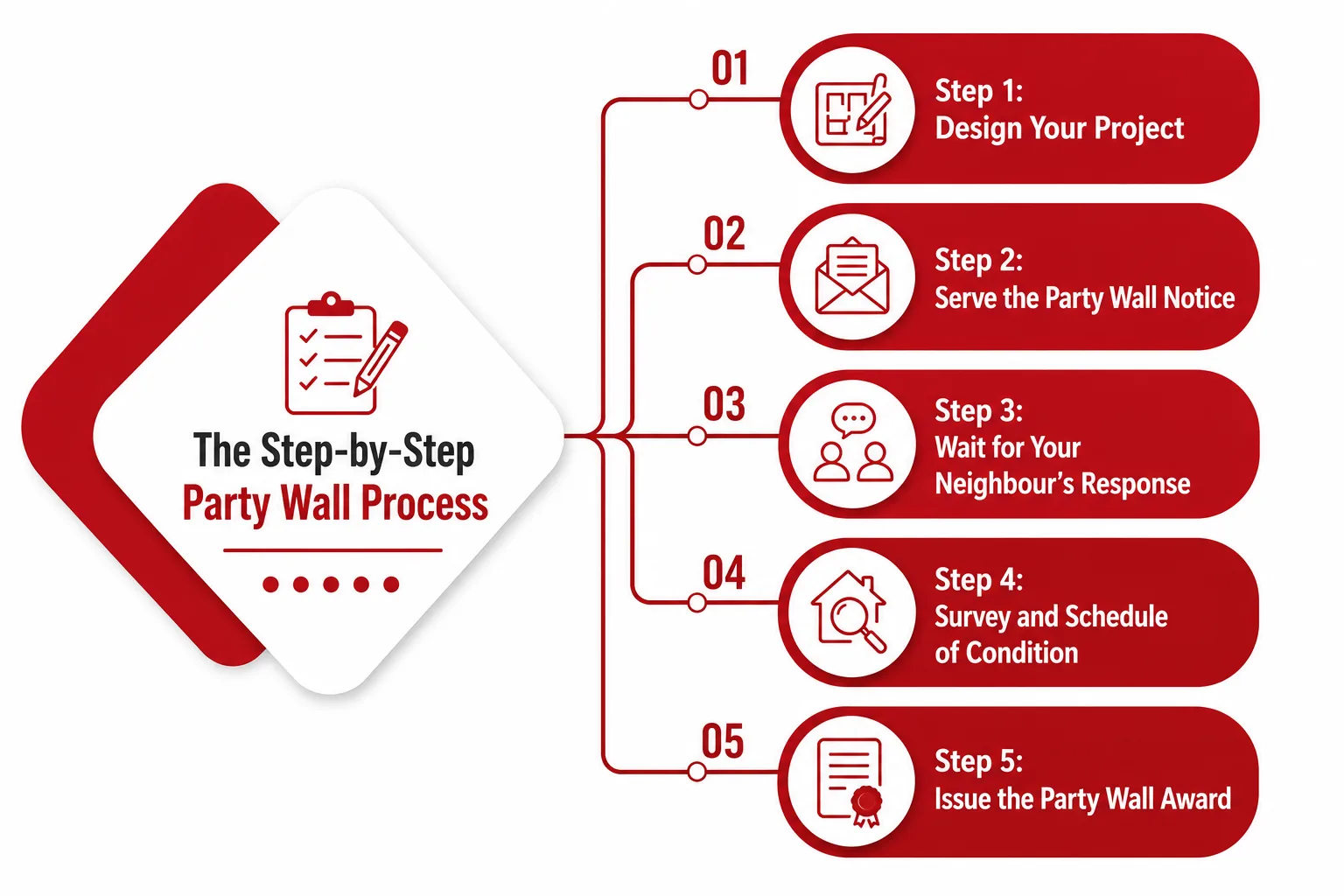
Understanding the process helps remove much of the uncertainty surrounding party wall matters.
Once architectural drawings are prepared, determine whether the proposed work falls under the Party Wall etc. Act.
Consulting a surveyor early can prevent expensive changes later.
Notices should normally be served between one and two months before work starts, depending on the type of proposed construction.
The notice must clearly describe the planned works and proposed start date.
Neighbours have three options:
If there is no response, a dispute is legally deemed to have arisen, and surveyors must become involved.
The adjoining property is inspected and existing defects are carefully documented.
This report provides valuable evidence should damage claims arise during construction.
The surveyor prepares the formal Award, outlining:
Once completed, construction can begin in accordance with the Award.
One of the first questions homeowners ask is how much professional assistance will cost.
Typical London fees are shown below.
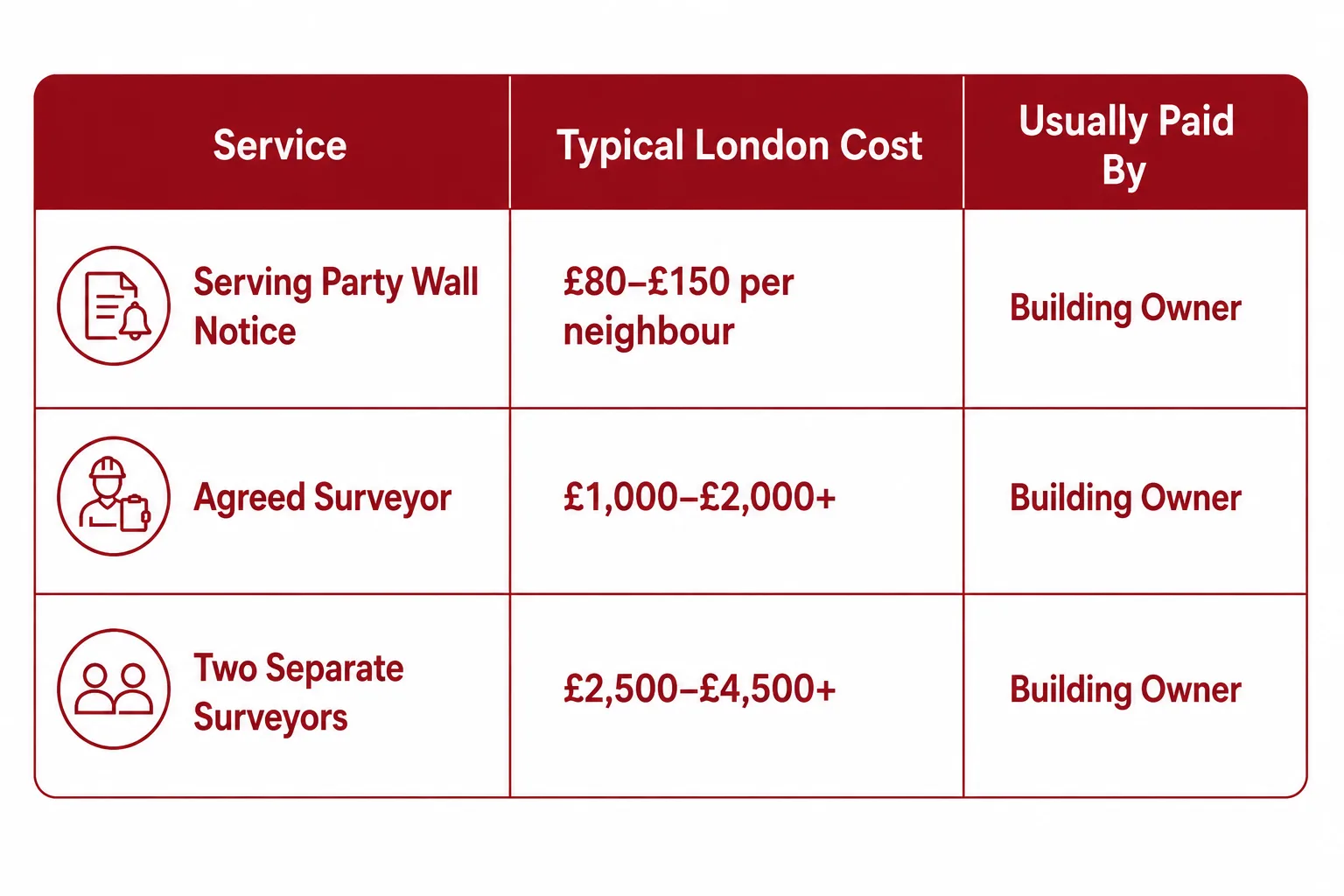
Several factors influence pricing, including:
Many homeowners searching for the best party wall surveyor in London focus solely on price. However, experience, efficiency and accurate documentation often save far more money than choosing the cheapest option.
Where neighbours agree to appoint a single Agreed Surveyor, professional fees can often be reduced substantially.

Professional guidance offers far more than legal compliance.
The Schedule of Condition creates independent evidence of the neighbouring property's condition before work begins.
This prevents false or exaggerated claims later.
A properly managed process greatly reduces the risk of injunctions or legal objections interrupting your build.
Experienced London party wall surveyors help remove emotion from discussions between neighbours, allowing practical solutions to be reached more quickly.
Having properly documented party wall awards demonstrates that construction was completed lawfully, something future buyers and solicitors often appreciate during property transactions.
Hiring a party wall specialist should not be viewed as an unnecessary administrative step but as essential protection for your construction project.
From serving legally compliant notices to preparing detailed party wall awards, resolving neighbour concerns and protecting your investment, specialist advice helps keep projects moving smoothly while reducing the risk of disputes, delays and unexpected costs.
Whether you're planning a loft conversion, basement excavation or home extension, seeking professional guidance at the earliest stage is one of the smartest decisions you can make.
If you're preparing for building work anywhere in London, contact Partywalls Limited for a free initial consultation and expert support tailored to your project.

If your neighbour does not reply within 14 days, they are legally deemed to have dissented. A surveyor can then be appointed to prepare the necessary Party Wall Award so the process can continue.
Generally, no. The Act is intended to facilitate construction rather than prevent it. As long as you comply with the legislation and follow the proper procedures, your neighbour cannot simply refuse the works without legal grounds.
If construction causes damage, the building owner is generally responsible for repairs.
The Schedule of Condition provides crucial evidence showing whether any defects already existed before work commenced.