.png)

Most homeowners don't wake up one morning expecting to be involved in a party wall dispute.
The project usually starts with something positive: a loft conversion to create an extra bedroom, a rear extension for a growing family, or perhaps that basement conversion that's been on the wish list for years.
Then a neighbour raises a concern.
Sometimes it's about excavation near a shared wall; sometimes it's scaffolding; sometimes it's simply that nobody explained what was happening before the builders arrived.
From that point, many people assume the worst: solicitors, court letters, and ever-mounting costs!
The reality is usually far less dramatic.
Most party wall disputes never get anywhere near a courtroom. In fact, many could have been avoided entirely with a conversation at the right time and a clear understanding of the Party Wall etc. Act 1996.
That's where Party Walls Free Advice can make a genuine difference. A short discussion with an experienced surveyor often highlights issues before they become problems. It can save money, reduce stress, and help neighbours stay on speaking terms throughout the project.
The disputes that end up costing the most money are rarely the ones involving the biggest building works.
They're often the ones where communication broke down early.
A homeowner assumes their neighbour won't mind. The neighbour assumes they're being ignored. Before long, both sides are arguing about principles rather than practical solutions.
The Party Wall Act was designed to avoid exactly this situation.
Its purpose isn't to encourage legal battles. It's to provide a structured process for dealing with construction work that affects neighbouring properties.
In practice, most disagreements are resolved through:
Take a typical London loft conversion.
The building owner intends to install steel beams into a party wall. The adjoining owner worries about cracks appearing in their property.
Without guidance, that concern can quickly become a dispute.
With guidance, a Schedule of Condition is prepared, the proposed works are reviewed, and both parties understand where they stand.
The issue often disappears before it has the chance to grow.

One detail that's often overlooked is that many disputes begin long before any formal disagreement exists.
A homeowner may be unsure whether the Act applies.
A neighbour may have received a notice they don't fully understand.
A contractor may have mentioned that surveyors are required, but nobody is quite sure why.
This is where Party Walls Limited’s Free Advice becomes valuable.
Typically, an initial consultation helps clarify:
What catches many homeowners out is how small misunderstandings can become expensive problems.
For example, someone may obtain planning permission and assume they are free to start construction. They later discover that planning permission and Party Wall procedures are completely separate matters.
That misunderstanding alone can delay a project and create unnecessary tension.
Seeking Party Walls Limited’s Free Advice early is often the cheapest step in the entire construction process.
The law itself rarely causes disputes.
People's assumptions about the law usually do.
Rear extensions are among the most common triggers for party wall matters.
Excavation near neighbouring foundations can raise concerns, particularly in older properties where construction methods differ from modern standards.
Neighbours often worry about movement, cracking, or long-term damage.
Even when those concerns prove unfounded, they still need addressing.
Loft conversions may look relatively straightforward from the outside.
Behind the scenes, however, steel beams are often inserted into shared walls.
Many homeowners are surprised to learn that internal works can still trigger Party Wall obligations.
Basement projects tend to attract greater scrutiny because the risks are potentially higher.
Excavating close to neighbouring structures naturally raises questions about foundations and stability.
Most adjoining owners simply want reassurance that their property is protected.
Boundary walls have a habit of creating disagreements because ownership is not always obvious.
One neighbour may assume the wall belongs entirely to them. The other may believe exactly the opposite.
Without proper investigation, these assumptions can quickly lead to conflict.
If there is one cause that appears more frequently than any other, it's poor communication.
We've seen projects involving substantial structural alterations proceed smoothly because neighbours were kept informed.
We've also seen relatively minor works create significant friction because nobody bothered to have a conversation beforehand.

This sounds almost too simple.
Yet it's astonishing how many disputes begin because neighbours first hear about a project from builders rather than the property owner.
An early conversation won't solve every issue, but it often prevents unnecessary suspicion.
The Act doesn't exist to make projects more difficult.
It exists because neighbouring properties can affect one another.
Understanding your obligations before work begins is far cheaper than discovering them halfway through construction.
A correctly prepared notice provides clarity.
It explains what work is proposed and gives adjoining owners an opportunity to respond through the proper channels.
Skipping this step often proves costly.
Good party wall advice is usually far less expensive than dealing with a dispute after it has escalated.
More importantly, it helps identify issues before positions become entrenched.
Many people hear the term party wall specialists and immediately think of paperwork.
That's only part of the picture.
Experienced party wall specialists spend much of their time preventing disputes rather than resolving them.
Their role may include:
The biggest saving is often invisible.
A surveyor may identify a potential problem before anyone else notices it. By doing so, they prevent a disagreement that could otherwise become expensive and time-consuming.
That's difficult to measure financially, but homeowners who have been through disputes usually appreciate the value.
Not every neighbour's disagreement relates to a party wall. Here at Party Walls Limited, we do not cover boundary disputes, but they are worth discussing.
Sometimes the issue is the boundary itself.
Perhaps a fence has been replaced in a slightly different position. Perhaps a wall sits somewhere neither owner expected.
This is where a boundary dispute surveyor becomes important.
A boundary dispute surveyor can investigate:
In practice, many boundary disputes are driven by assumptions rather than evidence.
Specialist Boundary Surveyors help establish the facts.
That alone can significantly improve negotiations.
Homeowners usually focus on the immediate cost of hiring a surveyor. And that's understandable.
What they sometimes overlook is the cost of not doing so.
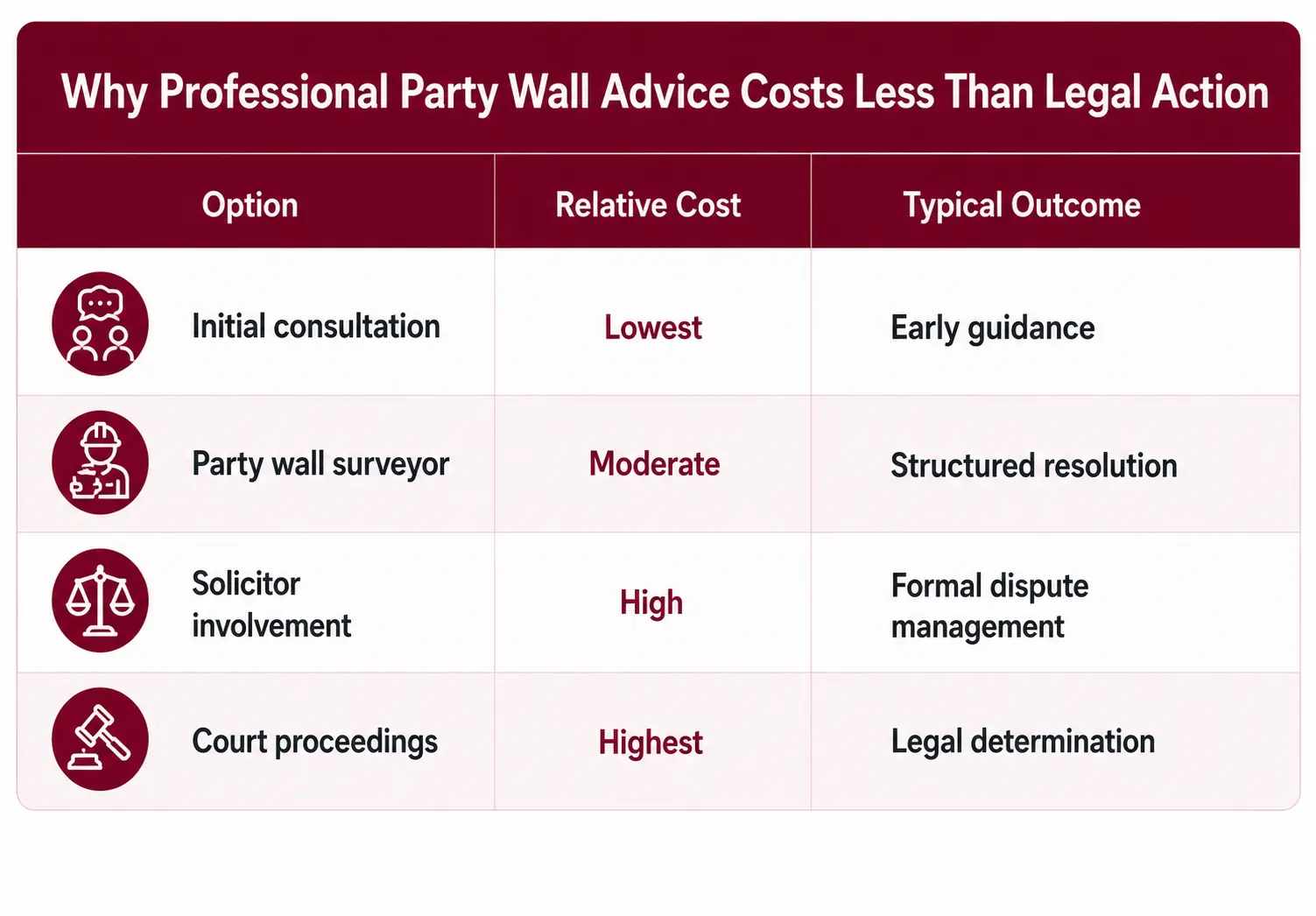
The reality is that professional party wall advice often prevents much larger costs appearing later.
Very few disputes start out serious.
They become serious because warning signs are ignored.
Common mistakes include the following:
The pattern is surprisingly consistent.
Most expensive disputes could have been significantly cheaper if addressed earlier.
The best dispute is the one that never develops.
A few simple habits can make a significant difference:
Good preparation isn't particularly exciting but it tends to be far cheaper than conflict.
When neighbour disputes arise, it's easy to assume that legal action is unavoidable.
In reality, court should almost always be the last resort.
Most party wall disagreements begin with uncertainty rather than hostility. One party isn't sure of their rights. The other isn't sure of the risks. Without clear guidance, misunderstandings fill the gap.
That's why Party Walls Limited’s Free Advice can be so valuable. A conversation at the start of a project often prevents far bigger problems later. Whether you're planning a loft conversion, rear extension, basement excavation, or boundary wall repair, understanding your responsibilities early gives everyone a better chance of reaching agreement.
Experienced party wall specialists deal with these situations every day. They understand the practical realities of construction, the legal framework behind the Party Wall Act, and the concerns neighbours commonly raise.
If you're planning building work or have concerns about a neighbouring project, seeking professional advice before construction begins is usually the simplest and least expensive route forward.
Contact Party Walls Limited to discuss your project and obtain expert guidance before small concerns become costly disputes.
Often, yes. Many surveyors offer an initial discussion without charge so homeowners can understand whether the Party Wall Act applies and what steps may be required.
Absolutely. Most disputes are resolved through the Party Wall process and surveyor involvement without solicitors becoming necessary.
The Act treats a lack of response as a dispute. Surveyors can then be appointed to resolve the matter and prepare a Party Wall Award.
It depends on the complexity of the project and the issues involved. Straightforward matters may be resolved within weeks, while more complicated disputes can take longer.
No. Some works do not fall under the Act. Obtaining professional advice early can help establish whether surveyor involvement is required.
The average cost of boundary dispute cases varies considerably. Minor disagreements may involve only surveyor fees, while court proceedings can run into many thousands of pounds.
Yes. Both owners can appoint a single Agreed Surveyor if they wish. The surveyor must remain impartial and act in accordance with the Party Wall etc. Act 1996.