.png)
Planning building work can be exciting at first. The drawings are approved, ideas start taking shape, and you can finally see how the finished project might look. Then somebody mentions the Party Wall process, and suddenly things become less straightforward.
Many homeowners are unfamiliar with Party Wall requirements until they're preparing a loft conversion, extension, basement excavation, or structural alteration. Questions about notices, neighbours, surveyors, and legal obligations can quickly create confusion. Most disputes don't arise because people are trying to be difficult. They happen because the process is misunderstood.
Understanding the most common Party Wall problems before work starts can save significant time, money, and stress later.
.webp)
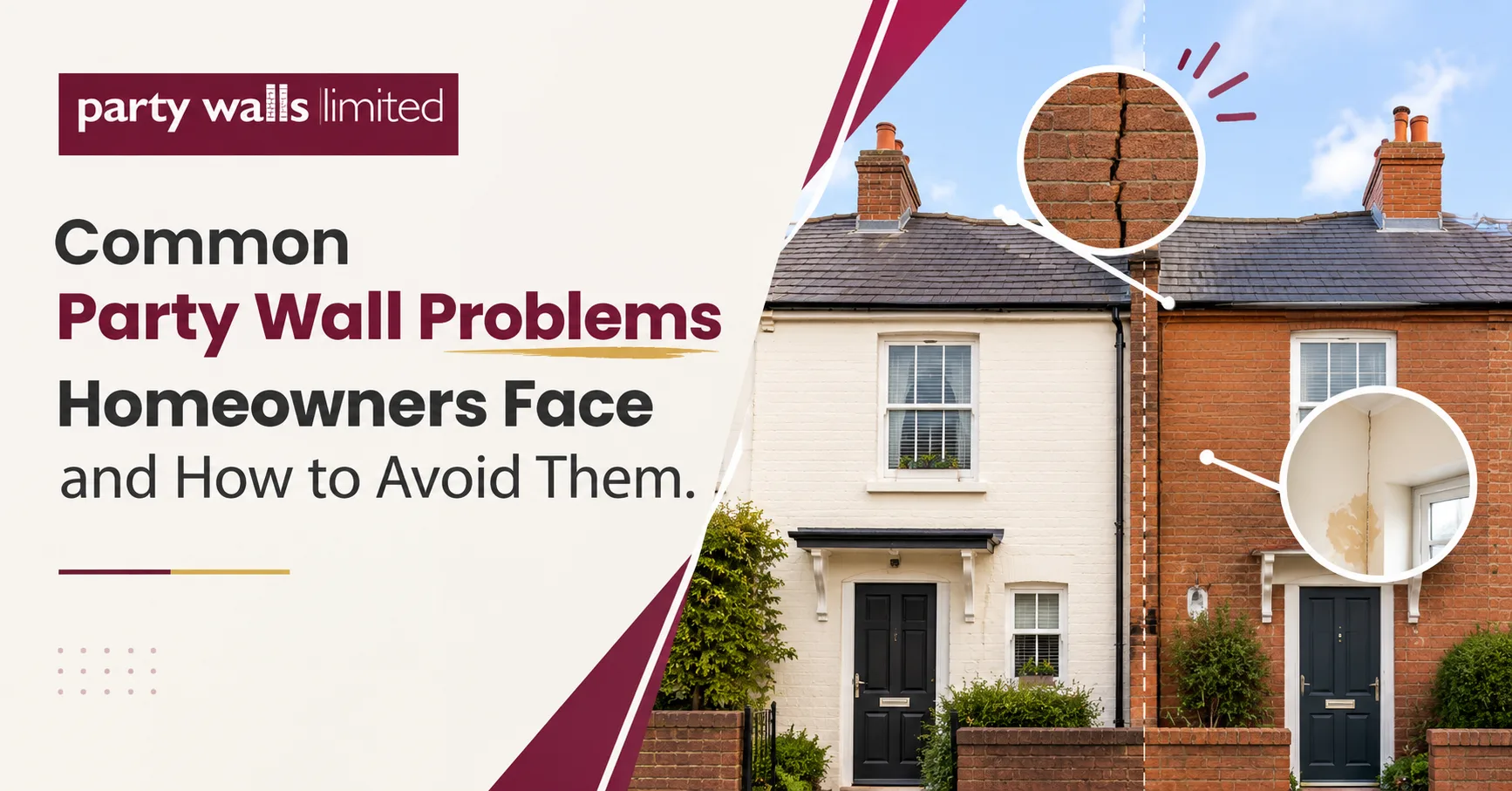
A Party Wall is usually a wall shared by two neighbouring properties. In many terraced and semi-detached homes, the wall separating the properties is a Party Wall. The Act can also apply to certain boundary walls and excavation works near neighbouring buildings.
The Party Wall etc. Act 1996 provides a legal framework that allows construction work to proceed while protecting neighbouring owners from unnecessary risk.
The legislation commonly applies when homeowners are:
The purpose of the Act is not to stop development. Instead, it helps ensure construction work is carried out fairly, safely, and with appropriate protections for everyone involved.

One of the most common mistakes is not serving a notice at all.
Many homeowners assume that because they have planning permission or Building Regulations approval, they are free to begin work immediately. Unfortunately, those approvals do not replace Party Wall obligations.
A loft conversion might appear relatively straightforward. However, if steel beams are inserted into a shared wall, the Act may apply.
When notices are overlooked, neighbours often discover the works after construction has started. That's when disputes tend to escalate.
Review your plans as early as possible and determine whether the Act applies before builders arrive on site. If you're unsure, seek professional advice.
Serving a notice is only half the battle.
Surveyors frequently encounter notices that contain missing information, incorrect dates, vague descriptions of work, or inaccurate property details.
A defective notice can invalidate the process and force homeowners to start again.
That often means delays to contractors, rearranged schedules, and additional costs.
Have notices reviewed by an experienced party wall surveyor before serving them. Small errors can create surprisingly large delays.
Technically, the Act does not require you to have an informal conversation before serving notice.
Practically speaking, it often helps.
Neighbours who receive formal legal documents without prior discussion sometimes assume the worst. They may worry about damage, disruption, noise, scaffolding, or access arrangements.
What could have been a simple conversation becomes a formal dispute.
Speak with neighbours early.
Explain:
Many potential disputes disappear before notices are even served.
Some building owners mistakenly believe that because they own the property, neighbours have no role in the process.
That's not how the Act works.
Neighbours have legal rights as adjoining owners under the Party Wall etc. Act. Although they cannot ‘object’ to the work as they can during the planning process, they can dissent to a party wall notice, appoint surveyors, and request that certain protections are included in the process.
Understand that neighbour involvement is a normal part of the Party Wall process. A dissent does not necessarily mean conflict. The formality of the wording (which is rather outdated!) can often seem intimidating to both owners, and can confuse messages between owners when open dialogue is not an option. It often simply means surveyors become involved.
This is one of the costliest mistakes homeowners make.
Builders are available. Materials are ordered. Deadlines are approaching.
The temptation is to begin work while paperwork catches up.
Unfortunately, starting construction before the Party Wall process is complete can create serious legal problems.
In some circumstances, neighbours may seek an injunction to halt works.
That can be far more expensive than waiting a few weeks for the process to conclude properly.
Do not begin notifiable works until notices, surveyor appointments, and any required party wall awards have been completed and served.
Construction projects inevitably create concerns about damage.
Sometimes cracks appear after work begins.
Sometimes they were already there.
Without evidence, disagreements can quickly arise.
This is precisely why surveyors prepare a Schedule of Condition.
The document provides a detailed record of the neighbouring property's condition before work starts.
Always consider preparing a Schedule of Condition before significant works begin.
The report typically includes:
A good Schedule of Condition protects both owners.
Even when construction is carefully managed, disputes about damage can occur.
The problem is not always the damage itself.
It's uncertainty about:
Without proper records, minor issues can become major disagreements.
A thorough Schedule of Condition, combined with professionally prepared party wall awards, provides a clear framework for handling any damage claims that arise.
The clearer the documentation, the easier these discussions become.
Many homeowners don't realise there are different surveyor options available.
Some immediately appoint separate surveyors without considering alternatives.
Others choose a surveyor solely based on price.
Both approaches can create unnecessary complications.
For straightforward projects, a party wall surveyor may be able to act for both owners.
This can reduce administration, simplify communication, and often lower costs.
In more complex situations, separate surveyors may be appropriate.
Discuss the available options before making appointments.
An experienced party wall surveyor can explain which surveyor arrangement is likely to suit your project.
Most Party Wall disputes are not caused by aggressive neighbours or complex legal arguments.
They're caused by misunderstandings.
A professional party wall surveyor helps homeowners navigate the process before those misunderstandings become expensive problems.
Their role may include:
An experienced surveyor also helps identify potential issues before construction starts.
In many cases, early involvement prevents disputes altogether.
Whether using an agreed party wall surveyor or separate surveyors, professional guidance often saves far more money than it costs.
Before construction begins, run through this simple checklist:
✓ Confirm whether the Party Wall Act applies
✓ Identify all affected neighbours
✓ Serve notices within the required timescales
✓ Speak with neighbours before formal notices arrive
✓ Appoint a suitable party wall surveyor
✓ Arrange a Schedule of Condition
✓ Wait for any required party wall awards
✓ Confirm access arrangements
✓ Keep written records of communication
✓ Do not begin work until the process is complete
A little preparation now can prevent significant delays later.
The easiest Party Wall dispute to resolve is the one that never develops in the first place.
Most problems arise because notices are delayed, neighbours are not informed, documentation is incomplete, or surveyors become involved too late. By understanding the process early and seeking professional guidance where needed, homeowners can avoid many of the issues that commonly derail projects.
If you're planning works that may affect a shared wall, obtaining advice before construction begins can help ensure a smoother project, fewer delays, and better neighbour relationships throughout the process.

Not usually. If the proposed works are covered by the Act and the correct procedures are followed, neighbours cannot simply prevent lawful development. They can, however, dissent to a served notice and require surveyors to become involved.
If the adjoining owner does not respond within the required period, a dispute is deemed to have arisen. Surveyors can then be appointed and the matter proceeds through the statutory process.
Most party wall awards include details of the proposed works, working hours, access arrangements, protective measures, responsibilities for repairs, and references to the Schedule of Condition.
In most circumstances, the building owner carrying out the works pays the reasonable fees associated with the Party Wall process, including surveyor costs.