.png)

Homeowners in the UK often assume that any disagreement with a neighbour during building work automatically falls under the same legal category. But in reality, boundary disputes and party wall matters are governed by entirely different procedures and professionals.
This distinction is important if you are planning loft conversions, basement excavations, rear extensions, chimney breast removals, or even simple fence replacements. However, misunderstanding the difference often leads to serious legal complications, project delays, neighbour conflicts, injunctions, and substantial unexpected costs.
A boundary issue generally revolves around ownership and the exact legal position of land or structures. While a party wall matter is related to construction works which may impact the shared walls or nearby neighbouring structures under the Party Wall etc. Act 1996.
Therefore, it is important to understand the correct legal route before the construction begins which can save thousands of pounds and at the same time, prevent your relationships with neighbours from deteriorating unnecessarily. If you are extending a Victorian terrace in London or replacing a garden wall elsewhere in England and Wales, professional guidance is essential.

Boundary disputes arise when neighbouring property owners disagree about the legal position of a property boundary or ownership of land and structures. These disagreements commonly involve:
In the UK, boundaries are usually determined using:
Boundary disputes are becoming more common in densely populated urban areas where homeowners are extending properties to maximise space instead of moving. As property values continue to rise, even small strips of land can become highly contentious.
The emotional and financial consequences can be severe. A simple disagreement over a fence panel can quickly escalate into:
Many homeowners eventually seek help from boundary dispute solicitors to resolve matters formally. And depending on the complexity of the project, the average cost of boundary dispute cases in the UK can range from a few thousand pounds to well over £50,000 in litigation.

A party wall matter is related to construction works that may impact shared structures or excavations near neighbouring properties under the Party Wall etc. Act 1996. A party wall notice thus becomes legally necessary when the works involve:
A formal party wall notice is usually required when:
The Act gives building owners certain legal rights but also imposes responsibilities to protect the adjoining owners. And professional surveyors play a critical role in helping homeowners:
Good Party Wall Advice early in the project can significantly reduce delays and costs. The Act also provides limited rights of access under certain circumstances, known as the party wall act right of access, where access onto neighbouring land is reasonably necessary to carry out the works.
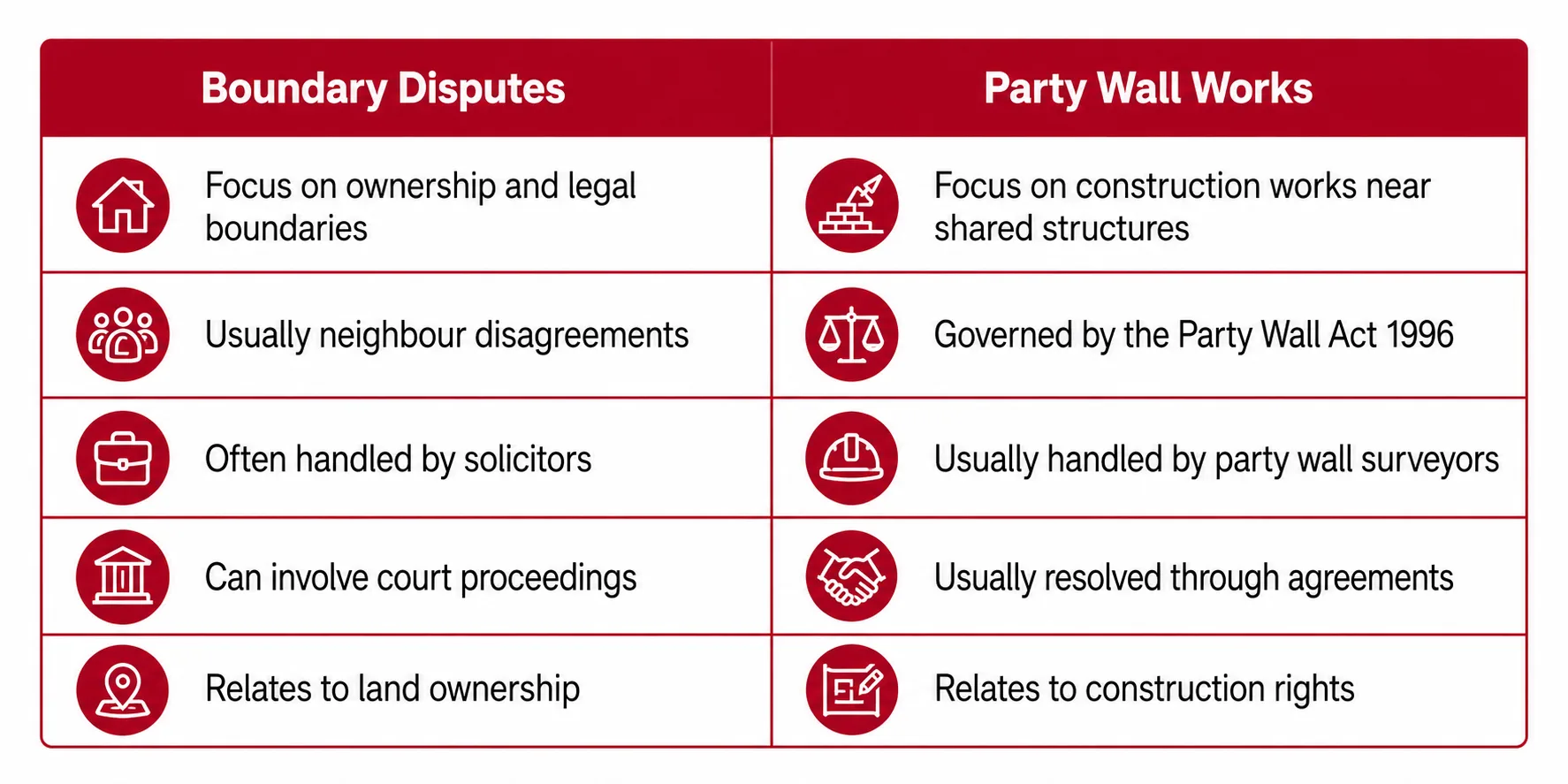
Boundary disputes are concerned about who legally owns a specific land or structures. Party wall matters, on the other hand, revolve around the right to undertake construction works safely and lawfully.
Boundary cases involve solicitors and courts while party wall matters are primarily managed by surveyors acting under statutory procedures.
Boundary disputes are genuine conflicts around the ownership while, party wall procedures are administrative processes designed to prevent disputes before they even arise.
It is important to note that:
“A project can involve both a party wall matter and a boundary dispute at the same time.”
For example, if a homeowner builds an extension that both affects a party wall and crosses the legal property boundary then both legal frameworks may apply simultaneously.
A disagreement becomes a serious legal issue when:
Homeowners often involve boundary dispute solicitors when informal discussions and mediation fail. Possible legal actions in such cases include:
Many people search online for advice on how to win a boundary dispute, but success usually depends on evidence quality, historic records, and expert surveying input.
Some firms also offer no win no fee boundary dispute arrangements, although these are generally reserved for strong cases with clear supporting evidence.
The Party Wall etc. Act 1996 exists specifically to reduce neighbour conflicts during construction works and the Act achieves this by:
Key documents include:
A Schedule of Condition is basically a documentation of pre-existing cracks, defects, and structural conditions before work begins. This protects both neighbours if damage allegations arise later. Proper documentation ensures:
The average cost of boundary dispute cases varies significantly depending on complexity.

“Ignoring a small disagreement today can become a five-figure legal dispute later.”
Many homeowners ask us: is there a time limit on boundary disputes?
The answer depends on the legal circumstances involved.
Relevant issues may include:
In some situations, delays can weaken evidence significantly. Old photographs, witness testimony, historic deeds, and physical markers may become harder to verify over time. Therefore, acting early is always advisable because delays can:
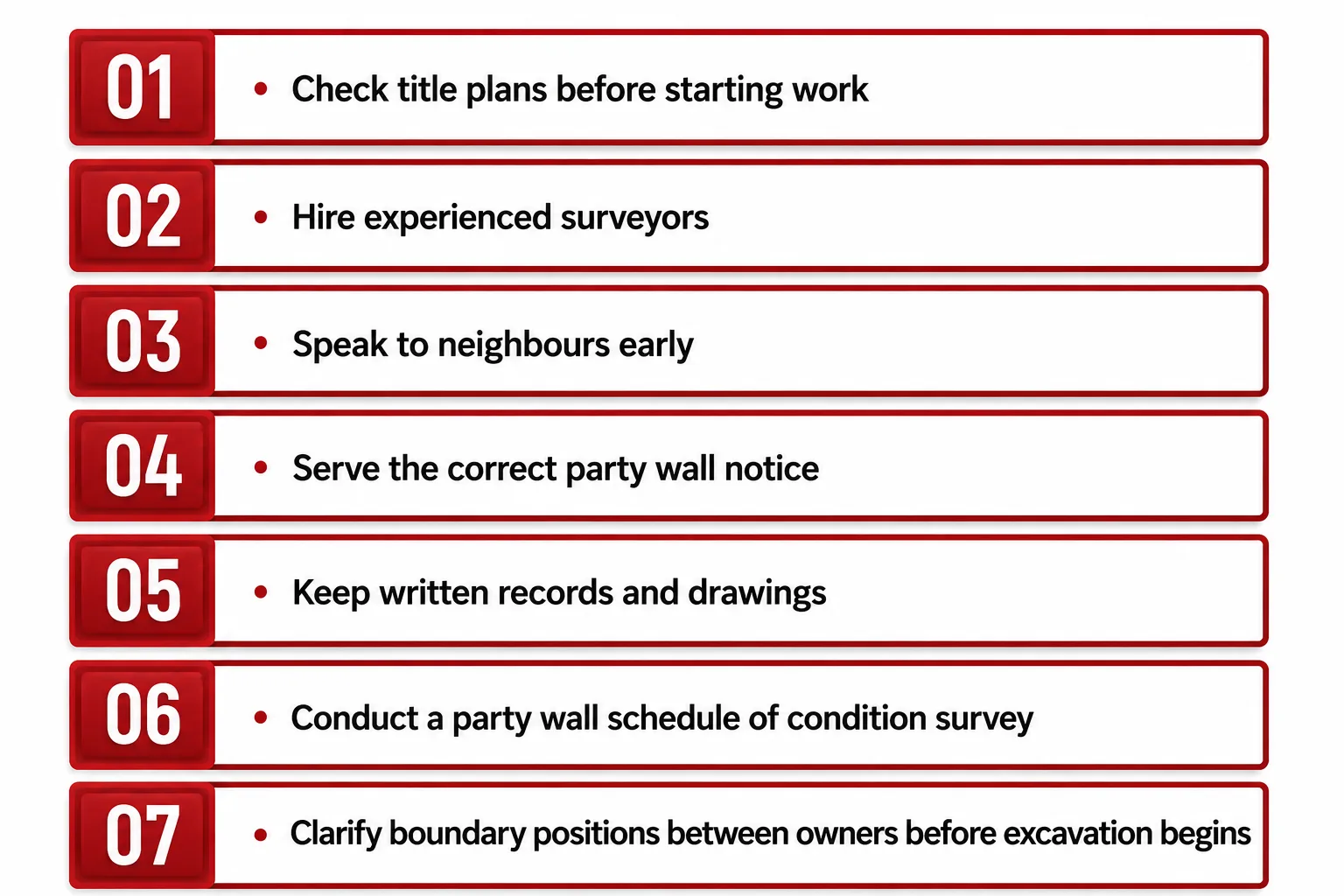
Clear communication and early planning often preserve neighbour relationships and prevent expensive legal battles.
The Party Wall Act Right of Access allows a temporary access to the neighbouring property which are reasonably necessary to complete the authorised works.
This may include:
However, important limitations also apply to the access:
Crucially, access rights do not create ownership rights over the neighbouring property. This Act balances construction rights with neighbour protections.
You should seek professional advice if:
Party wall surveyors are usually appropriate for procedural construction matters but solicitors become necessary where ownership, trespass, or litigation issues arise. Thus, early intervention is almost always cheaper and less stressful than resolving escalated disputes later.
Experienced surveyors can provide:
In party wall matters, surveyors make it sure that the notices, Awards, and Schedules of Condition are legally compliant. While in boundary-related situations, specialist surveyors can clarify physical boundary positions using measured surveys and historic documentation.
Experienced professionals often prevent misunderstandings before they escalate into costly legal disputes.

Boundary disputes and party wall matters are closely related in practice but legally they are very different issues. The former determines land ownership and legal boundaries, while the latter relates to construction rights and procedures under the Party Wall etc. Act 1996.
This distinction is important before starting building works as it can help you avoid delays, neighbour conflicts, injunctions, and expensive litigation. Proper notices, professional advice, clear documentation, and early communication are essential for smooth operations.
If you are planning a loft conversion, basement excavation, rear extension, or resolving a neighbour disagreement then expert guidance can save substantial time, money, and stress.
For professional UK-based Party Wall Advice, contact an experienced party wall specialist before work begins.
A boundary dispute is concerned about the ownership of land or structures, while a party wall matter revolves around construction works that may affect shared walls or nearby excavations under the Party Wall etc. Act 1996.
If your extension may affect a shared wall or you are planning excavations near neighbouring structures then you will need a formal party wall notice.
The average cost of boundary dispute cases ranges from around £1,000 for simple matters to over £100,000 for complex court litigation.
They can dissent or refuse consent, but this does not mean that the project stops. It triggers the statutory surveyor process under the Act.
Surveyors provide accurate measurements, legal documentation, condition reports, and professional guidance that reduce misunderstandings and evidential disputes.
This may constitute encroachment or trespass and can lead to legal action, compensation claims, or injunctions.
While not always legally mandatory, a Schedule of Condition is strongly recommended because it records existing defects and protects both neighbours.
Yes, in certain situations the Act provides limited temporary access rights where reasonably necessary to complete authorised works.