You've got planning in place. The builder is booked. Materials have been priced. Then the project suddenly hits a snag.
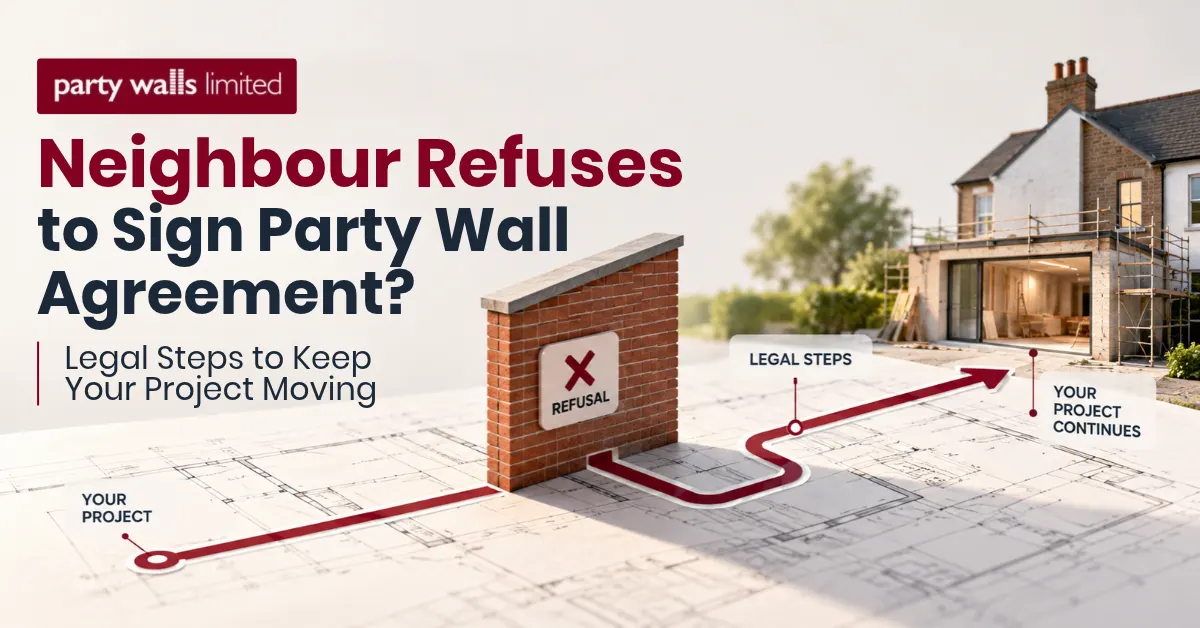
Your neighbour refuses to sign a party wall agreement or worse, they've stopped responding altogether.
It's one of the most common situations homeowners face before starting a loft conversion, rear extension, basement excavation, or other structural works. The uncertainty can be frustrating. Many people immediately assume their project is now on hold indefinitely.
The good news is that a neighbour's refusal does not automatically stop your work.
The Party Wall etc. Act 1996 was specifically designed to deal with situations where neighbours disagree, fail to respond, or have concerns about proposed construction. The legislation includes a clear process that allows projects to move forward while protecting the rights of both property owners.
Whether you're planning a loft conversion requiring a party wall agreement or carrying out excavation works close to neighbouring foundations, understanding the next legal steps can save weeks of confusion and unnecessary stress.

No. A neighbour cannot refuse to a party wall notice. If they refuse to respond at all, the Party Wall etc. Act 1996 has a framework to proceed matters without the neighbour’s input.
A neighbour, however, can dissent to a party wall notice, but this does not mean that the project is automatically stopping.
Under the Party Wall etc. Act 1996, an adjoining owner generally has three options after receiving a Party Wall Notice:
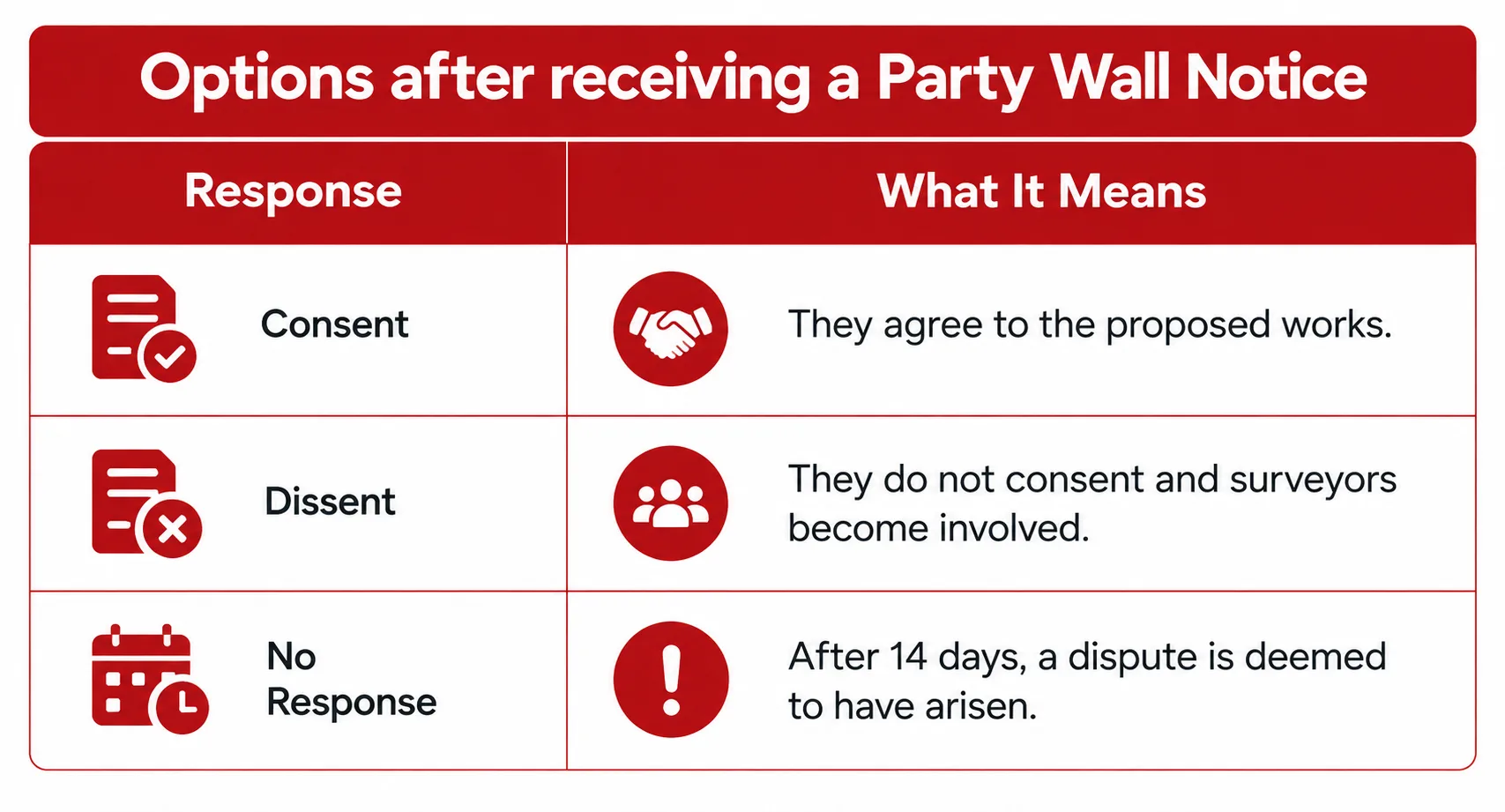
The important point is this:
A dissent is not a veto.
Provided the works are covered by the Act and the correct procedures are followed, the adjoining owner cannot simply block lawful development by refusing to sign.
One of the biggest myths surrounding Party Wall matters is that silence or refusal automatically kills the project.
It doesn't.
What it actually does is move the matter into the surveyor-led dispute resolution process established by the legislation.
In many cases, the issue isn't the proposed works themselves.
It's the uncertainty.
Some homeowners receive a Party Wall Notice and assume they're being asked to waive legal rights.
Others think they're accepting responsibility if something goes wrong.
Neither assumption is correct.
The notice simply starts a legal process.
A neighbour may be worried about:
These concerns are often reasonable and can usually be addressed through proper documentation and surveyor involvement.
Party Wall matters and boundary disputes are entirely different legal issues.
A neighbour who believes ownership boundaries are being challenged may refuse to engage until they understand the distinction.
Sometimes the Party Wall Notice isn't really the problem.
Previous disagreements about parking, fences, noise, or property maintenance can influence how a notice is received.
Where relationships are already strained, formal surveyor involvement often helps remove emotion from the process.
One of the most misunderstood parts of the Act concerns the response period.
After a valid Party Wall Notice has been served, the adjoining owner typically has 14 days to respond.
If they do nothing, the law does not treat this as consent.
Instead, under Section 5, a dispute is deemed to have arisen.
This is known as a deemed dissent.
Many building owners panic when this happens.
They assume something has gone wrong.
In reality, deemed dissent is simply another route through the Party Wall process.
Deemed dissent is not a failure, it simply moves you to the surveyor route.
It's worth understanding the difference:
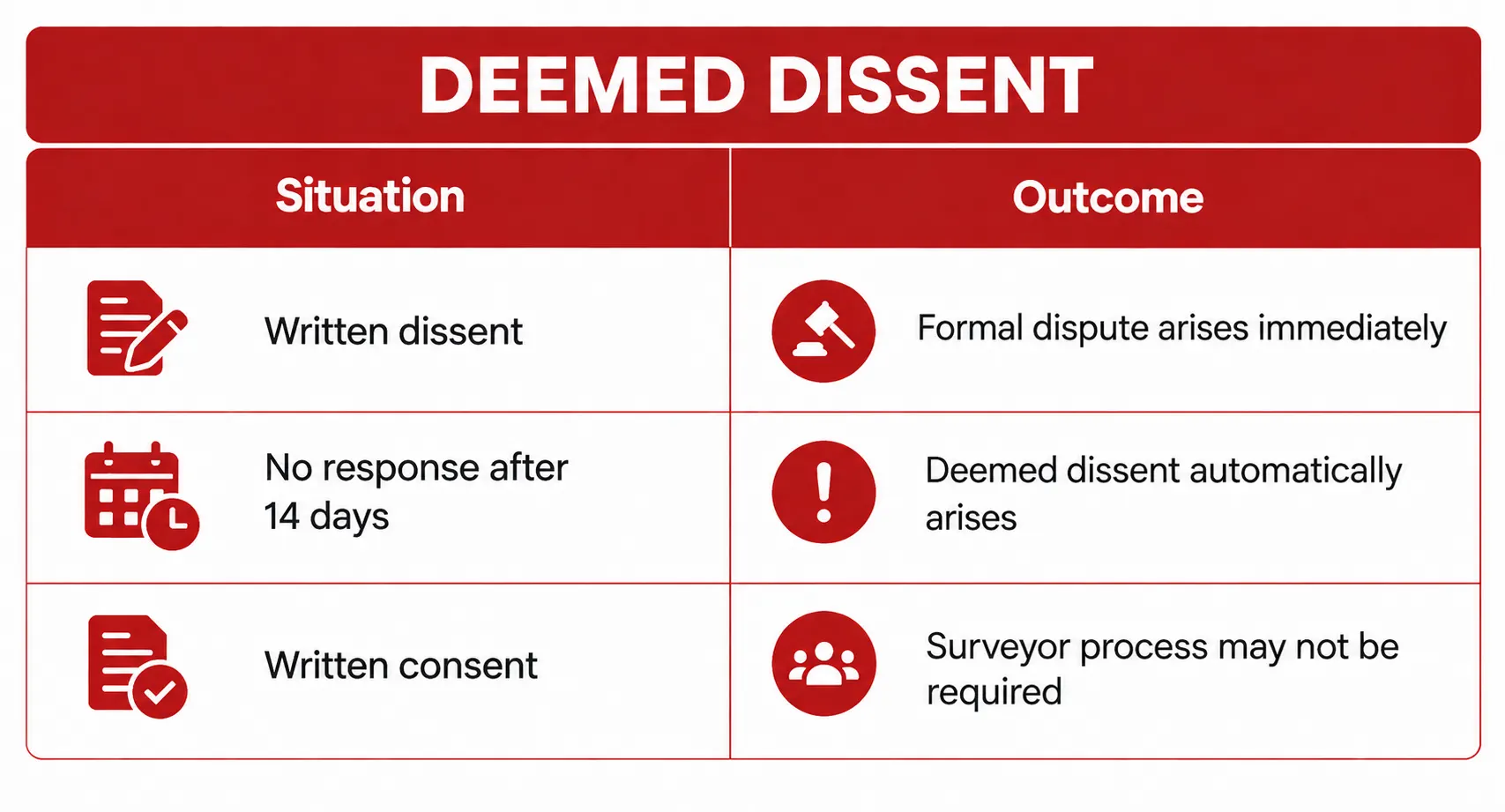
The practical outcome of written dissent and deemed dissent is usually the same: surveyors become involved to resolve the matter.
This is precisely why the Act remains effective even when neighbours refuse to engage.
Once a dispute has arisen, the next stage often catches homeowners by surprise.
If the adjoining owner has not appointed a surveyor, a further notice may be served under Section 10(4).
This notice requests that they appoint a surveyor within 10 days.
The purpose is straightforward.
The legislation wants every dispute to move toward resolution rather than remaining stuck indefinitely.
The adjoining owner can:
If they fail to appoint a surveyor within the 10-day period, the building owner may appoint one on their behalf.
There is an important restriction.
The surveyor appointed for the adjoining owner must be genuinely independent.
You cannot simply appoint your own surveyor to represent both parties without following the proper procedures.
This safeguard helps preserve fairness and impartiality throughout the process.
For many homeowners, this is the point where concerns about a non-responsive neighbour begin to disappear.
The Act contains mechanisms specifically designed to prevent deadlock.
Although the Party Wall Act provides a formal route forward, a conversation is often the fastest solution.
Ideally, this should happen before notices are served.
Many adjoining owners become far more comfortable once they understand a few key points.
For example:
A neighbour who initially intends to dissent may decide to consent after receiving a clear explanation of the proposed works and the safeguards in place.
This doesn't always happen.
But where communication remains open, projects often progress more smoothly and relationships tend to remain intact.
Once a dispute exists, surveyors become central to the process.
There are three main options.
Both owners agree to appoint a single surveyor.
The surveyor acts independently and owes duties to the Act rather than either neighbour.
Advantages include:
This route works particularly well where relations remain reasonably positive.
Each owner appoints their own surveyor.
The surveyors then work together to prepare the Party Wall Award.
This option can provide additional reassurance where the proposed works are complex or concerns already exist.
A Third Surveyor is selected when the original surveyors are appointed.
They do not usually become involved unless the appointed surveyors cannot agree on a particular issue.
Think of the Third Surveyor as a built-in dispute resolution mechanism.
Most projects never require their involvement.
A common misconception is that the dispute itself must be settled before construction can proceed.
In reality, the Party Wall Award is designed to resolve the dispute.
The award typically sets out:
Once served, the award becomes legally binding.
If either owner believes it contains errors or unfair provisions, they generally have 14 days to appeal through the County Court.
Unless successfully appealed, the award remains enforceable.
This document provides the legal framework that allows the works to proceed while protecting neighbouring properties.
Many homeowners worry that a neighbour's refusal will automatically lead to huge costs.
That's not usually the case.
In most circumstances, the building owner pays the reasonable surveyor fees associated with the process.
Typical factors affecting costs include:
Simple residential projects generally cost significantly less than complex developments involving multiple neighbouring properties.
The cheapest outcome is often early cooperation.
However, even where a neighbour refuses to engage, the surveyor process is usually far less expensive than formal litigation.
Ironically, neighbour objections are rarely the biggest cause of delay.
These mistakes are far more damaging:
This can expose homeowners to injunctions and legal complications.
Incorrect property details, dates, or descriptions can invalidate the process.
Failing to follow the statutory procedure can create avoidable delays.
Surveyors must remain independent.
Appointments that compromise impartiality can create challenges later.
Surveyor appointments and legal notices take time.
Projects run far more smoothly when Party Wall requirements are addressed early.
If your neighbour refuses to sign a party wall agreement, it does not mean your project has reached a dead end.
The Party Wall etc. Act 1996 was specifically written to deal with situations where neighbours disagree, fail to respond, or have concerns about proposed works. The process is designed to keep projects moving while protecting both parties.
The key is to follow the correct legal procedure and avoid rushing ahead before the necessary documentation is in place.
If you're facing a non-responsive neighbour or need advice on the next steps, speak to an experienced Party Wall Surveyor as early as possible. Professional guidance at the start of the process can save considerable time, cost, and stress later on.
Contact Party Walls for a free consultation and discuss your project before construction begins.

Not immediately. If the neighbour has not consented, the statutory dispute resolution process must be completed and any required Party Wall Award served before works begin.
After the appropriate notices have been served and the required timeframes have passed, a surveyor may be appointed on their behalf under the procedures set out in the Act.
In most cases, the building owner undertaking the work pays the reasonable professional fees associated with the Party Wall process.
Timeframes vary depending on the project and neighbour responses. Straightforward matters can progress relatively quickly, while more complex schemes may take longer.
They may have the right to appeal a Party Wall Award within the statutory period. However, most Party Wall matters are resolved through surveyors rather than court proceedings.
Yes. Good neighbour relations are helpful, but they do not remove legal obligations under the Party Wall etc. Act 1996 where the Act applies.