.png)

Homeowners planning extensions, loft conversions, or structural alterations often assume that two surveyors are always required under the Party Wall etc. Act 1996. In reality, many projects can be handled by a single professional known as the Agreed Party Wall Surveyor.
An Agreed Party Wall Surveyor is jointly appointed by both neighbours to act impartially and manage the entire legal process. This arrangement often saves significant time and money while still providing full legal protection for both properties.
For standard residential projects across London such as rear extensions or loft conversions, appointing an agreed surveyor can be the most efficient way to secure your Party Wall Award and begin building work without unnecessary delays.
Understanding how the process works can help you avoid complications and keep neighbour relationships positive throughout the project.
Read More :- Why Separate Surveyors are a "Safety Shield" for London Basement Digs
Under the Party Wall etc. Act 1996, an Agreed Surveyor is a single surveyor appointed by both the Building Owner (the person undertaking the work) and the Adjoining Owner (the neighbour).
Instead of each party appointing their own surveyor, both parties agree on one impartial professional to manage the process and produce the Party Wall Award.
This option is perfectly valid under the Act and is often recommended for straightforward residential projects where both neighbours are comfortable working with the same professional.
The key point to remember is that although the Building Owner usually pays the surveyor’s fee, the Agreed Surveyor does not represent one side. Their responsibility is to the legislation itself and to protecting the rights of both properties.
An experienced Party Wall Agreed Surveyor performs several critical functions during the process. Their work ensures that building projects comply with legal requirements while preventing disputes between neighbours.
The most important responsibility of an agreed surveyor is impartiality. Once appointed, their duty is not to either property owner but to the Party Wall etc. Act 1996.
This means they must fairly consider the interests of both parties when preparing the Award, assessing construction methods, and determining reasonable safeguards.
One of the most important tasks carried out by the surveyor is preparing a Schedule of Condition.
This is a detailed record of the adjoining property’s condition before construction begins. It usually includes written descriptions and photographic documentation of walls, ceilings, floors, and external areas close to the proposed works.
The schedule serves two important purposes:
For many London projects involving shared walls, this record provides vital evidence if a dispute arises after construction begins.
After reviewing the proposed works and conducting the necessary inspections, the surveyor prepares the legally binding Party Wall Award.
This document outlines:
Once the Award is served on both parties, the building work can proceed in accordance with the agreed terms.
Read More :- The Cost of an Agreed Surveyor in London
Choosing an Agreed Surveyor Party Wall arrangement offers several advantages for homeowners planning building work.
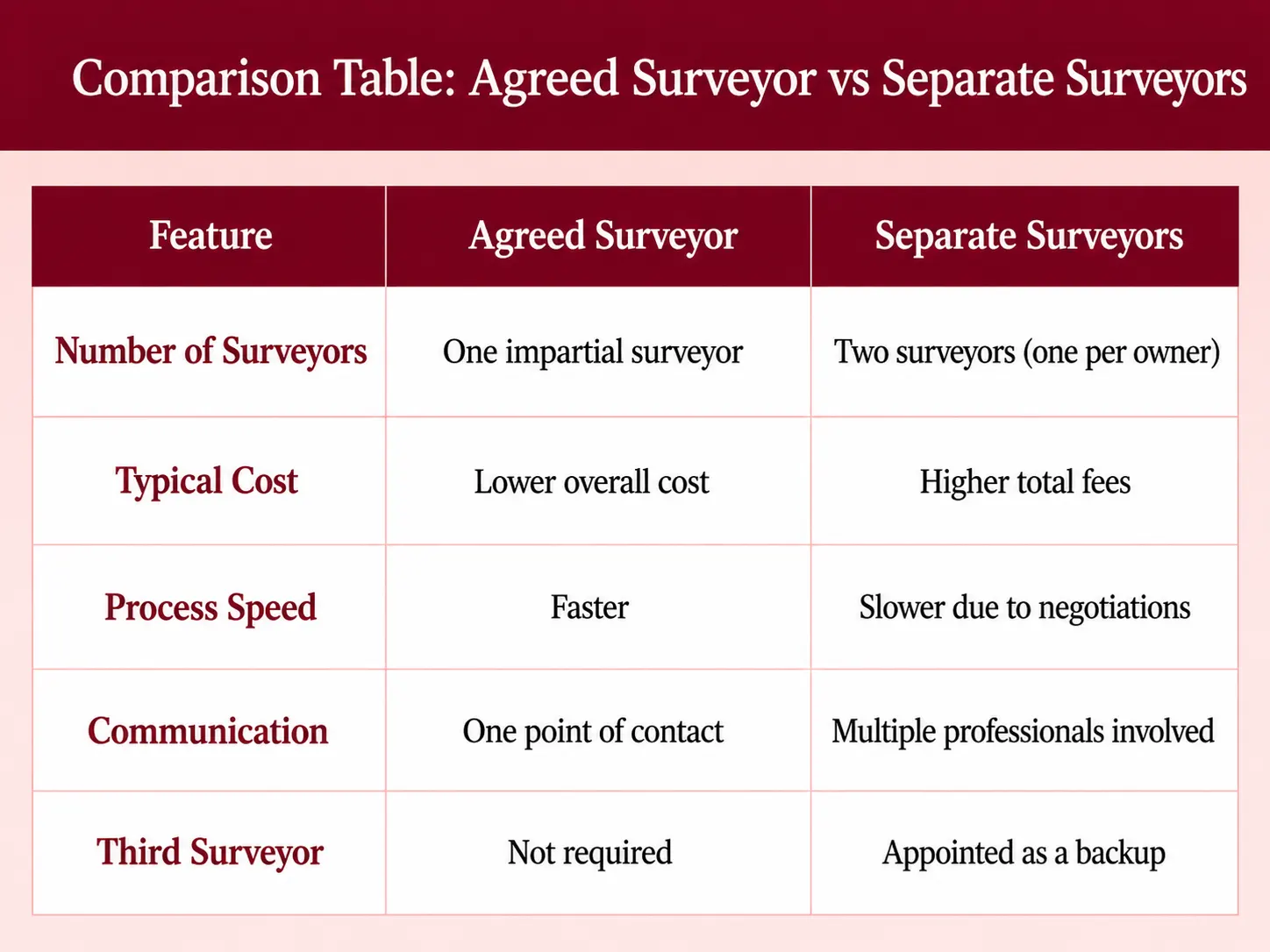
The most obvious benefit is reduced cost.
When two surveyors are appointed, the Building Owner usually pays both professional fees. This can quickly double the cost of the process.
With a single surveyor, there is only one professional fee, meaning homeowners can often save 50% or more on surveyor costs.
For standard residential projects, this can represent significant savings.
Using one surveyor also speeds up the process considerably.
When two surveyors are involved, they must communicate with each other, review documents separately, and negotiate certain aspects of the Award. This can extend timelines.
An agreed surveyor removes this layer of complexity. Because one professional manages the entire process, the Party Wall Award can often be issued much faster.
For homeowners working to renovation schedules, this time saving can be extremely valuable.
Another advantage is clarity.
When two surveyors are involved, homeowners may need to communicate through their own surveyor while the surveyors communicate with each other. This can sometimes slow down decisions or create confusion.
With a Party Wall Agreed Surveyor, there is only one point of contact. Both parties receive consistent advice and updates throughout the process.
This simple structure often helps maintain good neighbour relationships and reduces stress during construction.
While an agreed surveyor is often the most efficient option, it is not always the best choice for every project.
Understanding when to choose each arrangement can help you make the right decision.
This setup works particularly well for many residential properties across London.
In these cases, separate surveyors provide each owner with their own professional advisor, and a Third Surveyor is appointed in case of disagreements.
Read More :- Neighbor Refused Agreed Surveyor? | Expert Legal Advice
Read More :- Party Wall Act: The 3m & 6m Excavation Rules Explained
When using an Agreed Surveyor Party Wall arrangement, there is no Third Surveyor to resolve disagreements.
Once the Party Wall Award is served, both parties have 14 days to appeal the Award in the County Court if they believe it is incorrect or unfair.
Appeals are relatively rare in residential projects, but it is important for homeowners to understand this legal timeframe.
For many homeowners planning building works in London, appointing a specialist Agreed Party Wall Surveyor is the most efficient way to handle party wall matters.
It offers:
However, every project is different. Factors such as structural complexity, neighbour relationships, and project scale should all be considered when deciding whether to appoint a single surveyor or separate professionals.
Choosing the right surveyor structure can have a major impact on the cost, speed, and overall success of your building project.
If you are planning works that may fall under the Party Wall etc. Act, speaking with an experienced surveyor early in the process can help you avoid delays and ensure your legal obligations are met.
Planning a project in London?
Contact Party Walls Limited to find out whether an Agreed Surveyor is the right solution for your property and your neighbourly matters.
Neither. Although the Building Owner usually pays the fee, the surveyor has a statutory duty to remain impartial. Their responsibility is to ensure the work complies with the Party Wall etc. Act 1996 and that both properties are protected.
In many cases, homeowners save around 50% or more on professional fees. Because there is only one surveyor conducting inspections, drafting documents, and managing communication, the overall cost is significantly lower.
Yes. The Adjoining Owner has the right to appoint their own surveyor if they prefer independent representation. If this happens, the Building Owner will usually be responsible for paying both surveyors’ reasonable fees.
In a two-surveyor arrangement, a Third Surveyor acts as a tie-breaker. However, with an agreed surveyor there is no Third Surveyor. If either party disagrees with the final Party Wall Award, they must appeal the decision in the County Court within 14 days.
Yes. Preparing a Schedule of Condition is an important responsibility of the surveyor. It records the current condition of the neighbouring property before work begins and helps resolve any future damage claims.
An agreed surveyor may not be ideal if the project involves highly complex structural works, such as basement excavations, or if there is significant mistrust between neighbours. In these situations, separate surveyors provide additional reassurance to both parties.