
Many homeowners assume that every building project requires Party Wall notices, surveyors, and formal agreements with neighbours. In reality, a surprising amount of renovation work falls completely outside the Party Wall etc. Act 1996.
The confusion is understandable. You're replacing a kitchen, renovating a bathroom, or knocking out old plaster, and suddenly someone mentions Party Wall procedures. It can be difficult to know where routine home improvements end and legal obligations begin.
The Party Wall Act exists to protect neighbouring properties when certain types of work could affect shared walls, boundaries, or nearby structures. It was never intended to regulate every home improvement project.
Understanding which works are exempt can save unnecessary worry, while also helping you avoid the far more expensive mistake of overlooking works that do require formal notice.
The Party Wall Etc. Act 1996 applies to specific types of construction work that could affect neighbouring owners and shared structures.
At its core, the legislation provides a framework for balancing two competing interests: Property owners should be able to improve and extend their homes, but neighbours should also have protection when those works create risks.
The Act commonly applies to:
The legislation does not prevent construction from taking place.
Instead, it establishes a formal party wall process that allows works to proceed while protecting adjoining owners through notices, surveyor appointments, and Party Wall Awards where necessary.
This distinction is important because many homeowners mistakenly assume the Act applies whenever neighbours are affected by building work. In reality, only certain categories of work trigger its requirements.

The good news is that many everyday home improvement projects do not require Party Wall procedures at all.
Generally speaking, cosmetic, decorative, and non-structural works are usually exempt from the Party Wall Act.
Simple decorating projects rarely trigger the Act.
Examples include:
Even if the wall being decorated happens to be a party wall, these works are generally considered too minor to require formal notice.
Replastering is another common example.
Removing damaged plaster and applying a new finish normally does not affect the structural integrity of the wall.
As a result, replastering is usually outside the scope of the Party Wall Act.
The position can change if extensive structural repairs are involved, but ordinary plastering work is generally exempt.
Many kitchen refurbishment projects proceed without any Party Wall implications.
Replacing:
will rarely trigger the Act.
The situation changes if structural alterations are involved, such as cutting pockets into a party wall to support a steel beam.
A straightforward bathroom renovation is typically exempt.
Activities such as:
usually fall outside the Act.
Again, structural alterations are the factor that can change the position.
Homeowners often worry about attaching items to a shared wall.
In most cases, ordinary domestic fixings do not require notice.
Examples include:
The Act was never intended to regulate routine household maintenance and decoration.
Chasing shallow channels into the plaster for new electrical sockets or replacing internal wiring or upgrading sockets and installing lighting, or renewing plumbing systems generally does not require a party wall agreement.
Provided the work remains non-structural, these improvements are usually exempt.
Many roof repairs can also be completed without invoking the Act.
Replacing roof coverings, repairing flashing, renewing gutters, or fixing leaks typically falls outside Party Wall procedures, unless to do so, requires exposing the shared party wall to the elements.
However, structural roof alterations may require further consideration.
The key question is not whether work affects your property. It's whether it affects a party wall, boundary structure, or neighbouring property in a way contemplated by the legislation.
This is where many homeowners get caught out.
A project that begins as a simple renovation can evolve into something that falls squarely within the Party Wall Act.
The most common trigger is structural work.
For example:
A kitchen renovation might be exempt.
A kitchen renovation that involves removing a load-bearing wall and inserting structural steelwork may not be.
Similarly, redecorating a loft is unlikely to trigger the Act.
A loft conversion involving steel beams supported by a party wall often will.
The distinction matters because once qualifying works are proposed, the formal party wall process usually applies.
Ignoring that requirement can lead to delays, disputes, and potentially legal action.
One of the most misunderstood parts of the legislation is Section 6 of the Party Wall Act.
Unlike many Party Wall provisions, Section 6 is not necessarily focused on shared walls.
Instead, it deals with excavation near neighbouring buildings.
The concern is simple.
Digging near a neighbouring property can undermine foundations or affect structural stability.
Under Section 6 of the Party Wall Act, notice may be required if excavation is proposed:
These rules commonly affect:
Many homeowners are surprised to learn that excavation can trigger the Act even when no shared wall exists.
This is why professional advice is often recommended before excavation works begin.
Not necessarily.
This is a common misunderstanding.
Permitted Development Rights and the Party Wall Etc. Act 1996 are completely separate legal regimes.
A project may qualify as Permitted Development and still require Party Wall notices.
For example, a rear extension might not require planning permission but could still trigger obligations under Section 6 of the Party Wall Act or other provisions of the legislation.
Planning and Party Wall matters should always be considered independently.
Homeowners sometimes confuse the Party Wall Act, the Construction Act, and the 1984 Building Act.
Although all three relate to construction, they serve very different purposes.
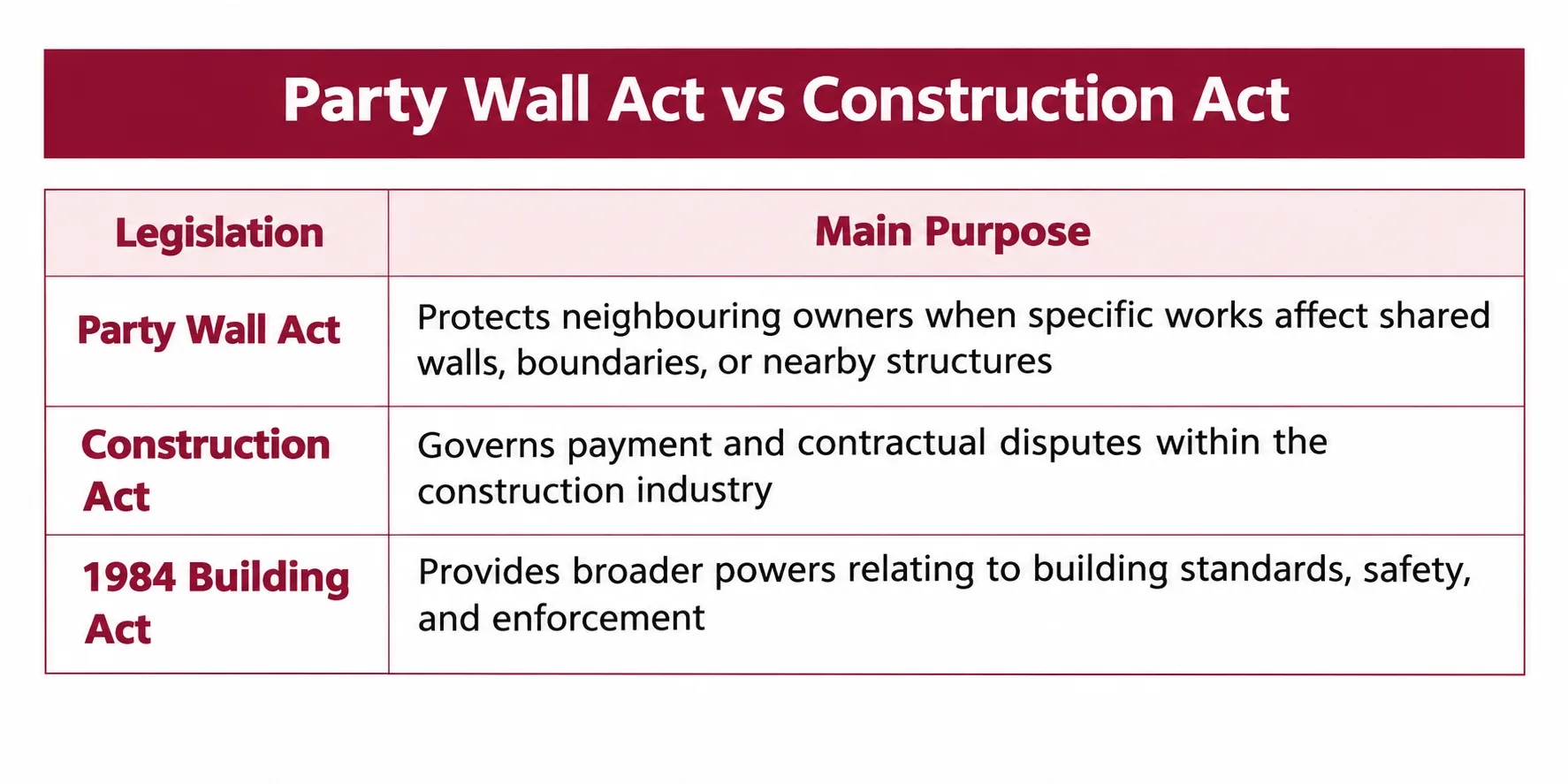
Compliance with one does not automatically satisfy the others.
A project may require Building Regulations approval under the 1984 Building Act while also requiring notices under the Party Wall Act.
If there is uncertainty, investigate before work starts rather than after.
Many disputes arise because homeowners assume the Act does not apply.
A brief discussion with an experienced surveyor can often clarify matters quickly.
A professional can review:
This is also often the stage where a Schedule of Condition is discussed.
A Schedule of Condition provides a record of the neighbouring property's condition before work begins and can be extremely valuable if concerns arise later.
Seeking advice early is usually far cheaper than resolving a dispute once construction is underway.
In most cases, no.
If works are genuinely exempt from the Party Wall Act, there is generally no requirement for a formal party wall agreement.
That said, neighbours sometimes choose to document arrangements voluntarily.
This can be helpful where access arrangements, scaffolding, or temporary protections are involved.
A voluntary agreement is different from a statutory Party Wall procedure.
The key point is that exempt work does not normally require formal notices, surveyor appointments, or Party Wall Awards.
The Party Wall Etc. Act 1996 does not apply to every home improvement project. Decorating, replastering, bathroom upgrades, kitchen replacements, ordinary drilling, and many repair works are typically exempt because they do not affect shared structures or neighbouring properties in a way contemplated by the legislation.
The position changes when projects become structural. Loft conversions, steel beam installations, chimney breast removals, and excavation works often trigger the formal party wall process and may require a party wall notice.
If you're unsure where your project sits, obtaining professional advice before work begins can prevent costly delays and misunderstandings. A quick review of your plans today is often far easier than resolving a Party Wall dispute once builders are already on site.

Usually not. Replastering is generally considered minor work unless it affects the structural integrity of the party wall or risks damaging the adjoining property.
A straightforward kitchen replacement normally does not require a party wall agreement. Structural alterations involving steel beams or significant alterations to a party wall may trigger the Act.
Ordinary drilling for shelves, pictures, mirrors, and wall units is normally too minor to require notice. Structural cutting into the wall is different and will often require Party Wall procedures.
Replacing bathroom fixtures and finishes is generally outside the Party Wall Act. Structural alterations affecting a party wall or shared floor structure may require the formal party wall process.
No. Many loft conversions require notice because steel beams are commonly inserted into or supported by a party wall.
No. The Party Wall Act applies in England and Wales only. Scotland and Northern Ireland operate under different legal arrangements.