Planning a loft conversion, rear extension or basement project in London? Alongside your architect's fees, structural calculations and building costs, you may also need to budget for a party wall surveyor.
The party wall surveyor cost in London is often one of the less obvious expenses homeowners encounter when preparing for construction. And if a neighbour dissents from your Party Wall Notice, the process can become more involved than you first expected.
So, how much should you budget?
Who is responsible for paying the surveyor's fees?
And does appointing one agreed surveyor actually save money?
Let's look at how party wall surveyor fees work, what influences them and what you can expect when appointing a surveyor.
There is no fixed statutory fee for a party wall surveyor. The cost depends on the proposed building work, the number of adjoining owners, the surveyor appointment arrangement and the amount of work needed to resolve any dispute.
A straightforward agreed-surveyor appointment will generally cost less than a complicated case involving two surveyors, several neighbouring properties or extensive structural work.
For reference, Party Walls Limited's published guidance places a typical London agreed-surveyor appointment to agree an Award in the region of £900–£1,400 plus VAT. This is an indicative company pricing range, not a fixed price for every project.
The actual fee will depend on what your project requires. A homeowner whose neighbour consents in writing may not need a surveyor to prepare a Party Wall Award at all. Another homeowner undertaking a basement excavation beside several adjoining properties may need a more involved surveying service.
Party Walls Limited's published pricing guidance provides the following reference:
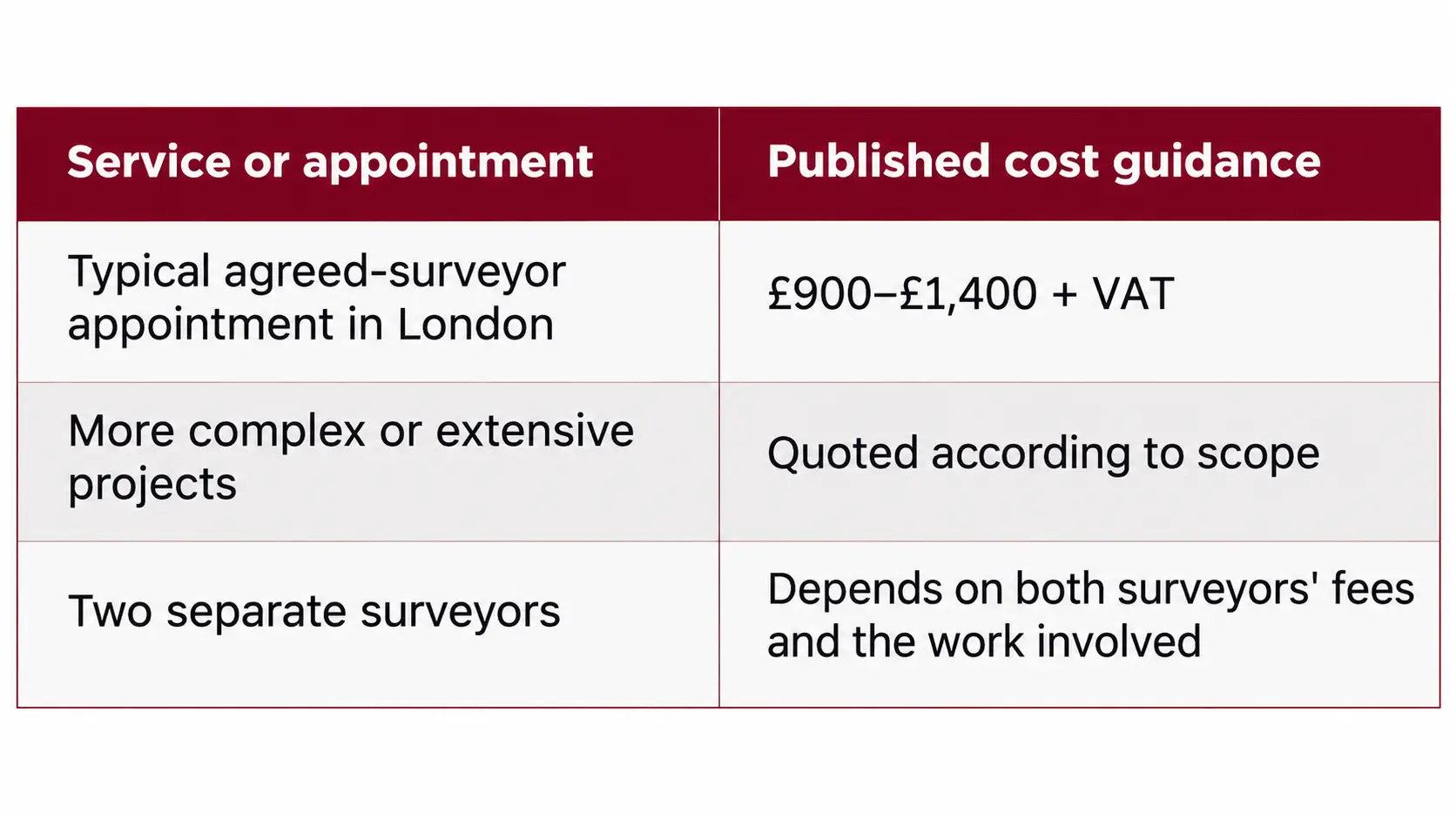
The figures above are not a universal London tariff. The final quote should clarify exactly what is included, how many adjoining owners it covers and whether additional inspections or work are charged separately.
Depending on the appointment, a surveyor's work may include:
Not every instruction includes all these services. For example, a fee for preparing and serving notices is different from a fee for a complete dispute-resolution service. Always ask for a written breakdown before appointing a surveyor.

In most cases, the building owner pays the reasonable surveyor costs when the proposed work is being carried out solely for their benefit. This will commonly include the fees of the adjoining owner's surveyor as well as the building owner's own surveyor, where two surveyors have been appointed.
However, the position is not automatic in every situation. The Party Wall etc. Act 1996 allows surveyors to determine how reasonable costs should be allocated, taking the circumstances of the work into account.
Usually, yes, where the work is solely for the building owner's benefit.
For example, imagine you're extending your London home and need to cut into a shared wall to insert a steel beam. Your neighbour dissents from the notice and appoints their own surveyor. You appoint a surveyor as well.
In this situation, the building owner will generally be responsible for the reasonable fees incurred by both surveyors in resolving the dispute and preparing the Award. The adjoining owner is not normally expected to pay simply because they have appointed someone to protect their interests.
Yes, although this is less common in ordinary home improvement projects.
There may be circumstances where the adjoining owner has to contribute to the costs. For instance, if work is required because a shared wall or structure is defective or needs repair, the costs may be apportioned between the owners according to their respective use of the structure and responsibility for the defect.
An adjoining owner may also have to pay for additional work they request that benefits their property. The exact position depends on the circumstances and the relevant provisions of the Act.
The surveyor or surveyors dealing with the dispute determine who pays the reasonable costs associated with making the Award, carrying out reasonable inspections and other matters arising from the dispute.
For work undertaken solely for the building owner's benefit, the building owner will generally bear these costs. However, the allocation can differ where the work also benefits the adjoining owner or relates to a shared defect or repair.
Unsure who is responsible for the fees in your situation? Speak to our team before proceeding with the appointment.

Two projects that appear similar on paper can involve very different amounts of surveying work. The following factors usually have the biggest influence on the final quote.
A straightforward alteration to an existing party wall may require less work than a basement excavation involving neighbouring foundations. The structural complexity, potential risks and information available all matter.
An agreed surveyor acts impartially for both owners. If each owner appoints their own surveyor, there are two professional appointments to manage, and the process may involve more correspondence and coordination.
A mid-terrace property may have more than one adjoining owner affected by the proposed work. Each relevant property may require separate notices, responses and surveying arrangements.
Some Awards are relatively straightforward. Others need detailed consideration of structural drawings, construction methods, working arrangements, protective measures and potential risks to neighbouring properties.
A Schedule of Condition, further site visits or additional inspections may increase the overall cost. These should be identified in the quote wherever possible.
Disputes over the method or timing of construction can require additional correspondence and consideration. Significant changes to the drawings after the process has started may also mean further work is needed.
When requesting a quote, provide as much information as possible. It gives the surveyor a better understanding of the project and makes it easier to explain the likely fees.
Read More :- Party Wall Disputes: A Homeowner’s Legal Guide
A Party Wall Award is a formal document prepared by the appointed surveyor or surveyors when a dispute arises under the Act. It sets out the relevant rights and obligations, the permitted works, how and when they should be carried out, and other matters connected with the dispute, including costs.
The party wall award cost is part of the wider surveying fee. It is not a separate statutory charge with a fixed national price. The amount depends on the work involved in reviewing the proposals, resolving the disputed matters and preparing the Award.
No. If an adjoining owner receives a valid notice and consents in writing, a formal dispute-resolution process is generally unnecessary. In that situation, a Party Wall Award is not normally required.
However, if the adjoining owner dissents or fails to respond within 14 days, a dispute is deemed to have arisen under the Act. The surveyor procedure under Section 10 must then be followed, and an Award is generally prepared to resolve the relevant matters.
Depending on the project, an Award may cover:
The surveyors' role is to resolve the matters in dispute impartially, not simply to approve the building owner's plans.
If you're comparing the agreed-surveyor route, our guide to the cost of an agreed surveyor in London explains the appointment and its pricing in more detail.
An agreed surveyor can often be a more economical option because there is one professional appointment rather than two separate appointments. However, it is not automatically the cheapest or most suitable arrangement for every project.
Under Section 10 of the Party Wall etc. Act 1996, both owners can agree to appoint one surveyor. Alternatively, each owner can appoint their own surveyor, who will then select a third surveyor.
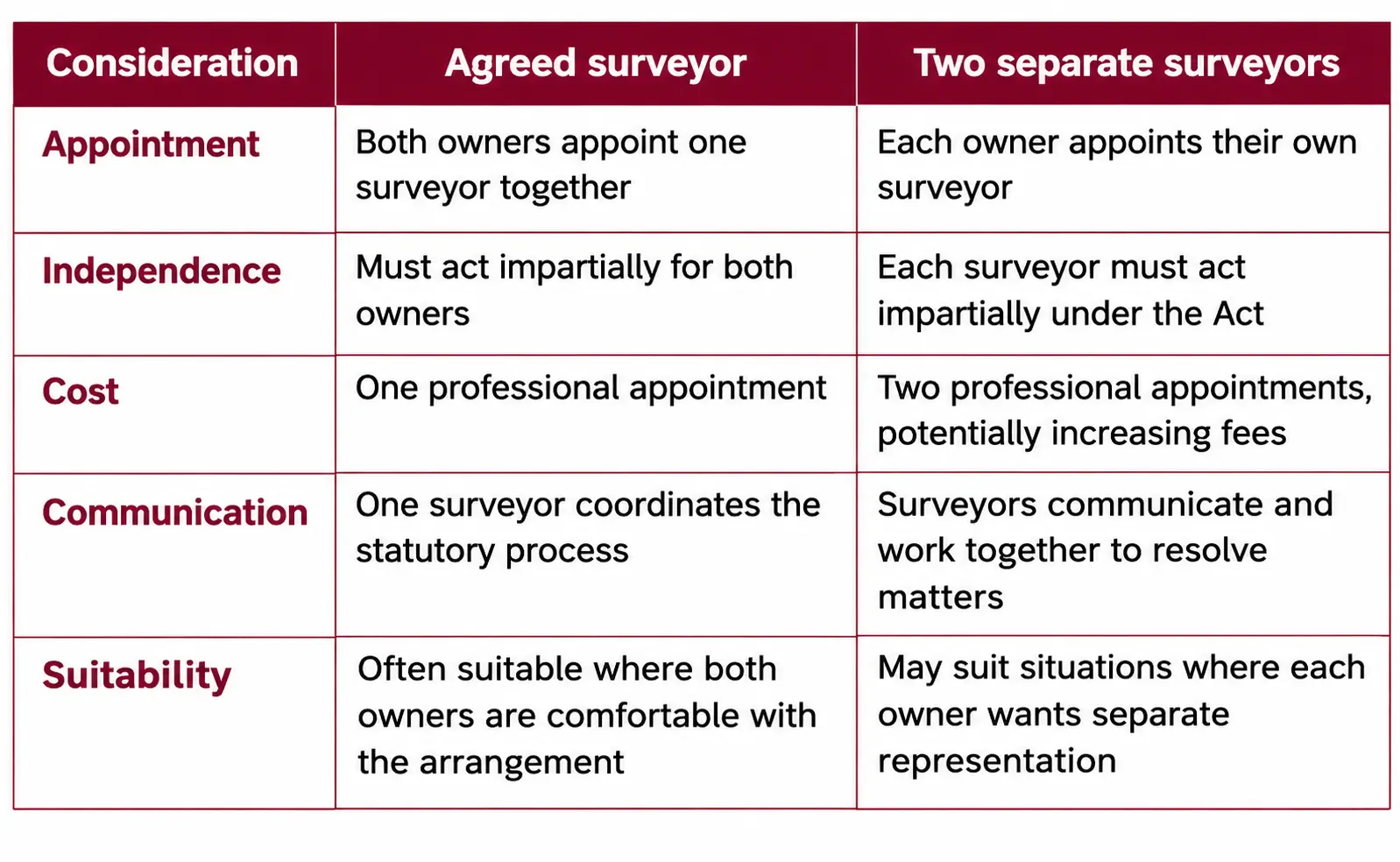
An agreed surveyor does not act as the building owner's representative or the neighbour's representative. Their statutory duty is to act impartially.
The choice should be based on the circumstances of the project and the confidence both owners have in the appointment, rather than cost alone.
Yes. The nature of your building work can influence the amount of surveying involved and, consequently, the fees.
Loft conversions can involve inserting steel beams or purlins into a shared wall, raising the height of a party wall or other structural alterations. These works may fall under Section 2 of the Act.
A straightforward loft conversion may require a relatively simple Award, while more complicated structural arrangements can involve additional drawing reviews and inspections.
Rear and side return extensions are common in London, particularly in terraced properties. Depending on the design, the work may involve a new wall at the boundary, alterations to an existing party wall or excavation near neighbouring foundations.
Where more than one adjoining owner is affected, separate notice and surveying arrangements may be needed for each property.
Basement projects can require more detailed consideration because excavation may affect neighbouring foundations. The surveyor may need to review foundation information, excavation drawings, structural proposals and the intended construction sequence.
Where the work involves underpinning a shared wall or other structural alterations, additional Party Wall Act provisions may also apply. This complexity can increase the amount of professional work required.
In most cases, yes. The statutory process normally begins with serving the relevant party wall notices on the adjoining owners.
A notice gives your neighbour the opportunity to respond to the proposed work. They can consent in writing, dissent or fail to respond within the statutory 14-day period. If they dissent or do not respond, a dispute is deemed to have arisen and the surveyor appointment process under Section 10 can begin.
There is an important distinction between obtaining help with the notice (which can also called ‘instructing’ a surveyor) and formally ‘appointing’ a surveyor to resolve a dispute. You can seek professional assistance with preparing and serving notices before a dispute exists. However, the statutory appointment of surveyors under Section 10 follows the dispute.
Not every project that requires a notice automatically needs a Party Wall Award. If the adjoining owner consents in writing, the dispute-resolution procedure is generally unnecessary.
You cannot control every part of the statutory process, but a little preparation can help prevent avoidable expenses.
The aim isn't simply to find the cheapest surveyor. It's to understand what the service covers and ensure the statutory process is handled properly.
If you're planning an extension, loft conversion, basement or structural alteration, it's worth understanding the likely surveying costs before your project gets underway.
To help us provide an informed quote, share:
Party Walls Limited works with property owners across London, helping them understand their responsibilities under the Party Wall etc. Act 1996 and the surveying services their projects may require.
Visit our Party Wall Surveyors London page or contact our team to discuss your plans.
Planning a loft conversion or extension in London?
Request a quote before starting the Party Wall process. A clear understanding of the likely fees and next steps can make budgeting and planning much easier.
Call 020 8877 0365 or get in touch through our enquiry form.
Get a Party Wall Surveyor Quote
The cost depends on the project, appointment arrangement and amount of surveying work required. Party Walls Limited's published guidance gives a typical London agreed-surveyor fee of £900–£1,400 plus VAT, although complex projects may cost more. Request a project-specific quote before making a decision.
Usually, the building owner pays the reasonable surveying costs when the proposed work is solely for their benefit. This can include the adjoining owner's surveyor fees. However, costs may be apportioned differently where the work involves shared repairs, defects or benefits to both owners.
Yes. Both owners can agree to appoint one surveyor under Section 10 of the Act. This is known as an agreed surveyor appointment. The surveyor must act impartially for both owners rather than represent one side against the other.
If your neighbour dissents, a dispute arises and the surveyor procedure under Section 10 must be followed. If they do not respond within 14 days, a dispute is generally deemed to have arisen. Surveyors can then be appointed to resolve the relevant matters and prepare an Award.
Not necessarily. You may need to serve notice if your loft conversion involves work covered by the Act, such as inserting steel beams into a shared wall. If your neighbour consents in writing, a formal surveyor appointment and Award may not be needed.
You can only proceed with notifiable work in accordance with the Act's requirements. If your neighbour consents in writing, a formal Award is generally unnecessary. If a dispute arises, the statutory procedure must be followed before the relevant work can proceed. Planning permission does not replace Party Wall Act compliance.
No. The Act does not set a standard fee scale for surveyors. Fees are agreed with individual surveyors, although the reasonable costs associated with an Award and related inspections are determined under Section 10. You can request a written breakdown if you are concerned about the amount charged.
It depends on the type of work, statutory notice period and whether a dispute arises. Notices for work to an existing party structure generally require two months, while certain other notices require one month. If surveyors need to be appointed and an Award prepared, allow additional time for the process.