.png)
Many London homeowners believe that if they are not touching a shared wall, they are “safe” from the Party Wall etc. Act 1996. Unfortunately, that assumption is one of the most expensive mistakes a property owner can make. In densely populated boroughs like Fulham, where narrow side returns or small gaps often separate houses, London’s 6m party wall rule is not a rare exception; it’s a constant legal presence. Ignoring this rule doesn’t just risk a neighbourly dispute; it can result in court-ordered injunctions that bring your project to an expensive standstill.
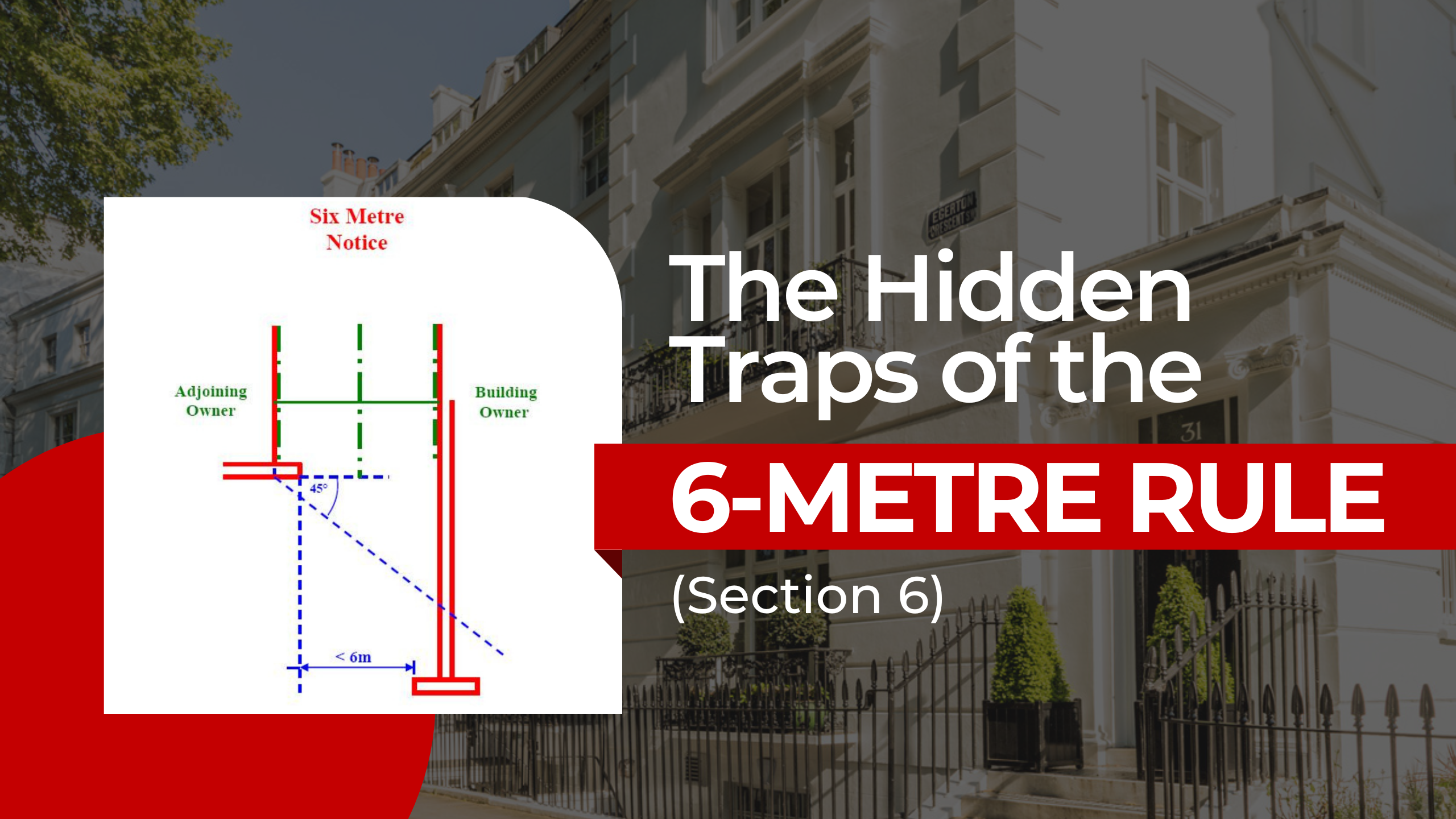
To determine whether Section 6(2) applies, you must assess the 45-degree plane of influence drawn from the bottom of your neighbour’s foundations. If your excavation intersects this zone, a notice is legally required.
In London, Victorian houses often sit on foundations just a few brick courses deep. Many homeowners guess that their neighbour’s foundations are deeper than they really are, and assume the 45-degree line is safely avoided.
That assumption is frequently wrong.
A neighbour’s surveyor can later prove that your excavation sits firmly within their Zone of Influence, triggering the Act retrospectively.
A judge will not accept “best guesses”. If the Act was triggered and no notice was served, your excavation becomes legally unauthorised. This exposes you to immediate legal action, including an injunction that can stop work overnight.
Modern construction methods, particularly piling, almost always engage Section 6. Even relatively modest extensions or garden structures can involve piles driven 10-20 meters into the ground.
Even if your excavation sits 5.8 metres away from your neighbour’s property, deep piling introduces vibration and soil displacement. Without a valid Section 6 Notice in place, you lose the Act’s dispute resolution framework entirely.
If a neighbour notices cracking or movement, they do not need to negotiate. They can proceed directly to a party wall injunction in Fulham or surrounding boroughs, and courts regularly grant them.
Section 6 is stricter than other parts of the act. A notice of excavation must include plans and sections showing the depths and locations of the works.
Sending a simple letter renders the notice legally invalid.
A savvy neighbour can wait out the 14-day notice period, allow you to appoint contractors, and then serve you an injunction on the morning the excavation starts, because your paperwork never complied with the Act in the first place.
The Trial Pit StandoffTo remove doubt around the 45-degree test, a surveyor may recommend a Trail Pit, a small excavation to confirm the neighbour’s actual foundation depth.
Trial pits require consent, as they are often dug on or near a neighbour’s land. If access is refused, your engineer is forced to design foundations “blind”.
To stay legally safe, engineers may over-design foundations with additional concrete and steel, potentially adding thousands of pounds to a project, simply to ensure compliance with the basement excavation party wall requirements.
If you are planning a basement or deep extension in Fulham (SW6) or Chelsea (SW3), follow the Safe-Start Rule: Assume the 6-metre rule applies until an RICS surveyor proves it doesn’t.
Serving a notice may cost a few hundred pounds. An injunction, plus one week of lost construction time, can easily exceed £10,000
The 6-meter rule is one of the most misunderstood parts of the Party Wall Act, yet it carries some of the most serious consequences. In London’s dense neighbourhoods, unknown foundations, deep piling, and basement excavations can trigger Section 6 long before any damage is visible.
Guessing, skipping, or relying on informal advice can expose a project to inconjunctions, delays, and high costs. Achieving certainty early, with proper assessment and valid notices, costs far less than recovering from a stopped site. When it comes to the 6-meter rule, compliance protects progress.
Don't risk an inconjunction or a delayed build.
A: This is the most common misunderstanding of the Act. While the 3-metre rule covers proximity, the 6-metre rule (Section 6(2)) covers depth and risk. If your new foundations (like a deep basement or piling) are deep enough to intersect a 45-degree plane drawn from the bottom of your neighbour’s foundations, you are legally required to serve a notice.
A: Yes. Many modern garden offices in London use screw piles to avoid tree roots. Because these piles can reach depths of 6–10 metres, they almost always hit the 45-degree plane of any neighbour within a 6m radius. If you skip the notice, you risk an immediate court injunction if a neighbour spots a piling rig on your site.
A: Unlike other notices, Section 6 has strict paperwork requirements. Under Section 6(6), your notice must include:
A: If foundations are "unknown" (common with Victorian houses in Fulham or Chelsea), surveyors often suggest a Trial Pit. This involves digging a small hole (usually by hand) next to the shared wall to confirm the footing depth. If the neighbour refuses access for a trial pit, you may have to design your foundations "blind," which often leads to expensive over-engineering to stay safely outside the 45-degree zone.
A: You lose the legal "shield" of the Party Wall Act. If damage occurs, you are fully liable and cannot use the Act’s dispute resolution process to resolve costs. Furthermore, neighbours can obtain an immediate injunction to stop your work, which can cost you thousands in contractor standing-time and legal fees.